
The Quilt Flying Geese – Pattern is one of the most iconic and recognizable designs in the world of quilting, representing a sense of movement, direction, and traditional charm. This specific motif consists of a large central triangle (the “goose”) flanked by two smaller right-angled triangles (the “sky”), creating a rectangular unit that mimics the V-formation of geese in flight. Whether you are building a border for a complex masterpiece or using the geese as the primary focus of a modern quilt, mastering the Quilt Flying Geese – Pattern is an essential skill that bridges the gap between basic piecing and advanced geometric design.
Engaging with a Quilt Flying Geese – Pattern allows a crafter to explore the fascinating relationship between color, value, and negative space. Historically, these units were used to tell stories of migration and journey, but in the modern sewing studio, they serve as a versatile building block for countless layouts, including stars, borders, and chevrons. Because the “geese” are inherently directional, they provide a unique opportunity to lead the viewer’s eye across the quilt top, creating a dynamic flow that flat squares simply cannot achieve.
In this detailed guide, we will break down the technical nuances that make a Quilt Flying Geese – Pattern successful, from the initial fabric selection to the final, crisp points that characterize a professional finish. We will focus on the various construction methods—ranging from traditional individual piecing to the modern “no-waste” technique—ensuring you find the workflow that suits your style. By understanding the math and the mechanics behind this patchwork unit, you will gain the confidence to incorporate flying geese into any quilting project with precision and artistic flair.
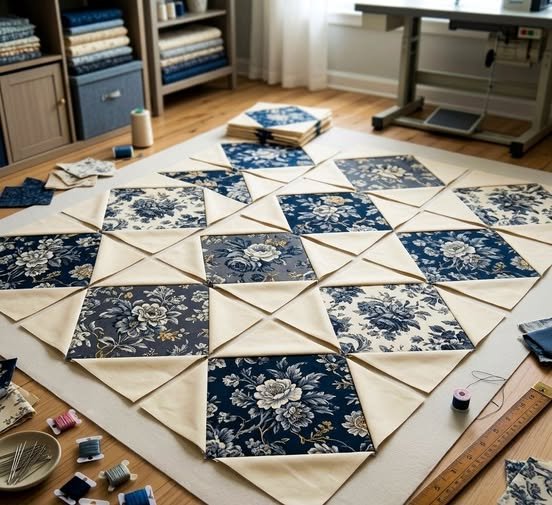
1. Foundation and Fabric Preparation for the Quilt Flying Geese – Pattern
The success of a Quilt Flying Geese – Pattern depends heavily on the visual contrast between the “goose” triangle and the “sky” triangles. To make the V-shape pop, it is common to use a vibrant or dark fabric for the central triangle and a lighter, neutral fabric for the corners. Choosing high-quality 100% quilting cotton is vital here because the many diagonal seams in this pattern create bias edges, which are prone to stretching if the fabric weave is too loose or inconsistent.
Color Value is a term you must master when planning your Quilt Flying Geese – Pattern. If the value of your goose fabric is too similar to your sky fabric, the distinct triangular shape will be lost, and your quilt will look muddled from a distance. A quick tip is to use a “grayscale” filter on your phone camera to view your fabric choices; if you can still clearly distinguish the triangles in black and white, your color palette is perfect for this design.
Understanding the Grain of the Fabric is particularly important for the Quilt Flying Geese – Pattern. Fabric grain refers to the direction of the warp and weft threads; cutting on the “straight of grain” provides the most stability. Since flying geese involve sewing on the diagonal, you will be handling bias edges. To prevent your geese from becoming “wonky” or distorted, many professional quilters recommend using fabric starch before cutting to give the cotton a paper-like stiffness.
The Cutting List for this pattern varies depending on the construction method you choose. For the traditional method, you will need one large rectangle and two smaller squares. For the “no-waste” Quilt Flying Geese – Pattern method, you start with one large square and four smaller squares. Using a rotary cutter and a non-slip acrylic ruler is the best way to ensure every piece is cut to the exact millimeter, as accuracy at this stage is the foundation of a flat quilt.
Fussy Cutting can add a layer of whimsy to your Quilt Flying Geese – Pattern. This technique involves centering a specific motif—like a small bird, a flower, or a geometric shape—within the large triangle of the goose. While it requires more fabric and careful alignment, fussy cutting transforms a standard geometric unit into a focal point of interest, making each “goose” in your formation tell its own little story within the larger quilt.
Lastly, consider Fabric Pre-washing if you are using high-contrast colors like red and white. Because the Quilt Flying Geese – Pattern often features sharp points of dark fabric resting against light backgrounds, any dye “bleeding” during the first wash can ruin the crisp aesthetic. Pre-washing ensures that your fabrics are colorfast and that they have finished any initial shrinking before they are sewn into your intricate patchwork design.
2. Technical Assembly and the No-Waste Method
One of the most revolutionary ways to execute a Quilt Flying Geese – Pattern is the No-Waste Method (also known as the four-at-a-time method). This technique allows you to create four identical geese units simultaneously without trimming away any “waste” triangles. By marking diagonal lines on four small squares and nesting them onto one large square, you can sew, cut, and press your way to a perfectly matched set of geese, significantly increasing your quilting productivity.
The Scant Quarter-Inch Seam is the most critical technical term to remember during assembly. Because a Quilt Flying Geese – Pattern involves many intersections where points must meet, your seam allowance must be exactly a “scant” quarter-inch—just a hair narrower than a true quarter-inch. This tiny adjustment accounts for the thickness of the thread and the fold of the fabric, ensuring that the finished unit is exactly the unfinished size required by the pattern.
Nesting Seams is a technique used when joining multiple flying geese units together in a row. By pressing the seam of one unit upward and the next unit downward, the fabric “locks” together at the seam line. This prevents the units from shifting under the sewing machine needle, which is the secret to achieving those perfectly aligned “points” where one goose follows another in a continuous formation.
The term Dog Ears refers to the tiny triangular bits of fabric that stick out at the corners after you have sewn and pressed your flying geese. In a high-quality Quilt Flying Geese – Pattern, you must trim these dog ears away before joining units. Removing this extra bulk ensures that your seams lay flat and that your sewing machine doesn’t encounter “speed bumps” that could lead to skipped stitches or misaligned rows.
Chain Piecing is an essential workflow for anyone making a large Quilt Flying Geese – Pattern. Instead of stopping to cut the thread after each seam, you feed the fabric pieces through the machine one after another in a long chain. This method not only saves thread but also helps you maintain a consistent sewing speed, which naturally leads to more uniform stitches and a faster completion time for your quilt top.
Finally, we must discuss Pressing for Success. In a Quilt Flying Geese – Pattern, you should always “press” (lift and set the iron) rather than “iron” (slide the iron). Sliding can easily stretch the bias seams, turning your perfect rectangle into a trapezoid. Pressing towards the “sky” triangles is a common rule to prevent the darker “goose” fabric from shadowing through the lighter background, ensuring a clean and professional finish.
3. Creative Layouts and Geometric Variations
The beauty of the Quilt Flying Geese – Pattern lies in how the units are arranged to create different visual effects. A Vertical Column of geese creates a sense of upward or downward motion, often used in modern “minimalist” quilts. Alternatively, arranging the geese in a Circle or Star formation (like the Dutchmans Puzzle) creates a spinning, kaleidoscopic effect that highlights the geometric precision of your patchwork skills.
Secondary Patterns often emerge when you play with the orientation of the geese. For example, if you place two rows of geese pointing toward each other, the “sky” triangles meet to form a new diamond shape in the center. This “accidental” geometry is one of the most rewarding aspects of the Quilt Flying Geese – Pattern, allowing a simple unit to create a highly complex and sophisticated quilt design.
The concept of Negative Space is vital for modern interpretations of the Quilt Flying Geese – Pattern. Instead of filling the entire quilt with geese, you might place a single “flight” of geese across a large expanse of solid-colored fabric. This draws all the attention to the geese and provides a massive area for decorative quilting stitches, making the finished piece feel like a work of contemporary textile art.
Directionality is a key consideration when using printed fabrics. If your “sky” fabric has a directional print (like stripes or animals), you must be careful how you cut and sew them to ensure the print doesn’t end up upside down or sideways. Taking the time to plan your fabric orientation within the Quilt Flying Geese – Pattern shows a high level of craftsmanship and results in a more cohesive and professional-looking finished product.
You can also experiment with Sizing and Scale. A quilt made entirely of tiny 1-inch geese looks incredibly intricate and delicate, while a quilt made of giant 12-inch geese has a bold, graphic impact. Mixing different sizes of the Quilt Flying Geese – Pattern within the same quilt top creates a “perspective” effect, making some geese look like they are farther away than others, adding depth to your handmade creation.
Lastly, consider the Border. Using flying geese as a border is a classic way to “frame” a central medallion or a series of blocks. A Flying Geese Border adds a sense of containment and movement to the edges of the quilt. It requires careful mathematical planning to ensure the geese fit perfectly into the length of the sides, but the result is a high-end, “show-quality” look that elevates any Quilt Flying Geese – Pattern.
4. Finishing Touches and Quilting the Geese
Once your Quilt Flying Geese – Pattern top is complete, it is time for the “Quilt Sandwich”—layering the top, the batting, and the backing. For a pattern with so many points and seams, a low-loft cotton batting is often the best choice. It allows the quilt to lay flat and ensures that the quilting stitches can be seen clearly without the “puffiness” of high-loft polyester obscuring your beautiful patchwork.
Basting is the process of securing these three layers together. Whether you use safety pins or a temporary spray adhesive, proper basting is essential for the Quilt Flying Geese – Pattern. Because there are so many seams, the fabric layers can be thicker in some areas than others. Secure basting prevents the layers from shifting and creating “puckers” on the back of the quilt as you move it through your sewing machine.
When it comes to the quilting design, Stitch in the Ditch is a popular and effective way to secure the Quilt Flying Geese – Pattern. By sewing exactly in the “valleys” of the seams, you highlight the triangular shapes and give the “geese” a slightly raised, 3D appearance. This method is perfect for those who want the patchwork design to remain the primary focus of the finished quilt.
For a more modern look, you might choose Echo Quilting. This involves sewing lines that follow the shape of the triangles, about a quarter-inch away from the seam. Echoing the Quilt Flying Geese – Pattern emphasizes the sense of movement and “flight,” making the geese look like they are creating ripples in the air as they move across the quilt surface.
The Binding is the final fabric strip that finishes the edges of your quilt. For a Quilt Flying Geese – Pattern, a contrasting binding can act like a frame, while a matching binding allows the design to bleed off the edges. Using a double-fold bias binding ensures that the edges of your quilt are durable enough to withstand years of use and washing, protecting your hard work for generations.
Finally, don’t forget the Quilt Label. A Quilt Flying Geese – Pattern is a labor of love and a testament to your technical growth as a quilter. A label with your name, the date, and the name of the pattern ensures that the story of your “geese” is preserved. It is the final professional touch that turns a beautiful blanket into a cherished heirloom, marking the successful completion of your quilting journey.
FAQ: Frequently Asked Questions about the Quilt Flying Geese – Pattern
1. Is the Quilt Flying Geese – Pattern hard for beginners?
It is considered an advanced-beginner unit. While the shapes are simple, the accuracy required for the points can be a challenge. However, by using the no-waste method and a scant quarter-inch seam, most beginners can produce beautiful, sharp geese with just a little bit of practice.
2. Why do I keep losing the points of my geese?
This is a common issue! It usually happens because the seam allowance is too wide. When you sew your units together, make sure your needle is exactly a quarter-inch from the point of the triangle. If you sew on the point, it will be hidden in the seam. Sew just a hair above the point to preserve it.
3. What is the best size for a flying geese unit?
The most common size is a 2:1 ratio, such as 2″ x 4″ or 3″ x 6″ (finished size). This proportion is what creates that classic “goose” look. Most Quilt Flying Geese – Patterns are built around these standard dimensions, making them easy to integrate into other block designs.
4. How many geese do I need for a twin-size quilt?
This depends on your layout! If you are making a quilt entirely of 3″ x 6″ geese, you would need hundreds of units. However, many Quilt Flying Geese – Patterns use geese as accents or borders, requiring far fewer. Always refer to your specific pattern’s yardage requirements.
5. Can I make flying geese with scraps?
Absolutely! A scrappy Quilt Flying Geese – Pattern is a wonderful way to use up your fabric stash. You can make each “goose” a different color while keeping the “sky” fabric consistent to create a unified but eclectic look. This is a favorite style for “wonky” or “improv” quilts.
6. Do I need special rulers for flying geese?
While you can make them with standard rulers, there are specialized Flying Geese Rulers that help with trimming and squaring up. These rulers have markings for the “seam allowance” points, making it much easier to ensure your units are perfect before you sew them into the quilt top.
Conclusion
In this article, we have thoroughly explored the world of the Quilt Flying Geese – Pattern, covering everything from the importance of fabric grain and color value to the efficiency of the no-waste assembly method. We discussed how small technical details like the scant quarter-inch seam and trimming dog ears make a massive difference in the quality of your finished project.
Whether you are using geese to create secondary patterns, bold minimalist layouts, or traditional star blocks, this motif remains a cornerstone of the quilting craft.