
The Block Log Cabin – Pattern is one of the most iconic and beloved designs in the world of quilting, representing a beautiful fusion of tradition, history, and geometric precision. At its heart, this quilting technique involves a central square—traditionally red to represent the hearth of a home or yellow to represent a light in the window—surrounded by strips of fabric that mimic the logs of a pioneer cabin. Whether you are a seasoned quilter or a beginner looking for your first project, mastering the Block Log Cabin – Pattern offers a satisfying experience that results in a timeless piece of art.
Exploring the Block Log Cabin – Pattern allows for endless creativity, as the arrangement of light and dark fabrics can create a variety of stunning visual effects. From the classic “Barn Raising” layout to the “Sunshine and Shadows” style, this versatile quilt block adapts to any aesthetic, from rustic farmhouse to sleek modern decor. Because the construction relies on straight lines and consistent seam allowances, it is often recommended as a foundational project for those learning precision sewing and fabric coordination.
To achieve a professional finish when working with a Block Log Cabin – Pattern, understanding the importance of fabric contrast and grain line alignment is essential. This article will dive deep into the mechanics of creating this block, exploring how to choose the right materials, the step-by-step assembly process, and how to troubleshoot common issues like “bowing” or “twisting.” By the end of this guide, you will have a comprehensive understanding of how to execute this classic patchwork design with confidence and flair.
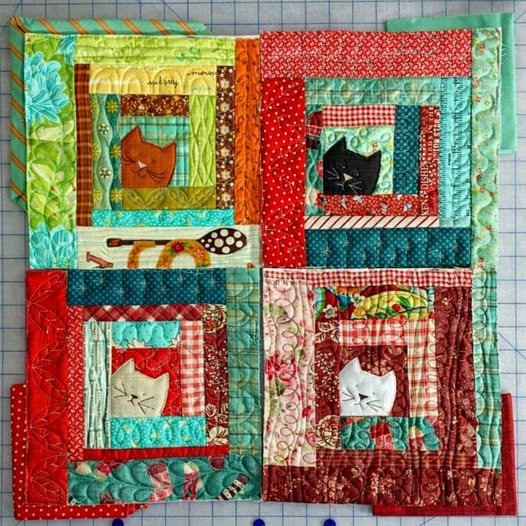
1. Understanding the Anatomy of a Block Log Cabin – Pattern
The fundamental structure of a Block Log Cabin – Pattern begins with a central “seed” square, which serves as the focal point for the entire design. Traditionally, this center is a solid color that anchors the surrounding strips, known as “logs,” which are added in a specific numerical sequence.
Choosing your fabric palette is the most critical step in defining the look of your quilt. Most quilters divide their fabrics into two distinct groups: high-contrast lights and deep darks, which allows the signature “diagonal” split of the block to emerge clearly during assembly.
The “logs” in a Block Log Cabin – Pattern are typically cut into strips of a uniform width, such as 2.5 inches, which is a standard size for jelly roll quilts. This uniformity ensures that the finished block remains square and the geometric lines stay crisp and professional.
Sewing follows a clockwise or counter-clockwise rotation, where each new strip is sewn onto the previous unit. This additive process means that as you move outward, the strips become progressively longer, requiring careful pinning and alignment to prevent the fabric from stretching.
One of the reasons the Block Log Cabin – Pattern remains a staple in the quilting community is its forgiving nature. Even if your strips are slightly off, the repetitive nature of the design often masks small imperfections, making it a great skill-builder for novices.
Modern variations of the Block Log Cabin – Pattern might use “wonky” or “improv” cutting techniques to create a more contemporary, abstract look. However, the core logic remains the same: building outward from a center point to create a sense of growth and stability.
2. Essential Tools and Materials for Success
Before you begin your Block Log Cabin – Pattern project, gathering high-quality quilting supplies will make the process much smoother. You will need a reliable sewing machine, a rotary cutter, a self-healing cutting mat, and a clear acrylic ruler for precise measurements.
The quality of your cotton quilting fabric matters immensely, as cheaper materials can fray or bleed during washing. Opting for 100% cotton ensures that the blocks maintain their shape and that the seam allowances can be pressed flat without excessive bulk.
A quarter-inch presser foot is a secret weapon for anyone working on a Block Log Cabin – Pattern. Since the block is built from many small pieces, even a tiny deviation in your seam width can result in a finished block that is significantly smaller than intended.
Thread choice is another factor often overlooked; a high-quality 50wt cotton thread is ideal because it is strong yet thin enough to disappear into the seams. Using a neutral color thread like grey or tan allows it to blend with both the light and dark strips of your pattern.
Ironing is not the same as pressing, and in the Block Log Cabin – Pattern, pressing is king. You should press your seams away from the center or toward the dark fabrics to avoid “shadowing,” where dark seam allowances show through lighter fabrics.
Finally, consider using marking tools or a design board to keep your strips organized. Because the Block Log Cabin – Pattern requires a specific order of assembly, having a visual reference prevents the common mistake of sewing a “light” log where a “dark” one should be.
3. Step-by-Step Assembly and Layout Techniques
To start your Block Log Cabin – Pattern, sew your first light-colored log to the right side of your center square. After pressing the seam open or to the side, you will then sew the next light log to the bottom of that new unit, creating the first “tier” of your cabin.
The third and fourth logs will typically be your dark-colored fabrics, sewn to the left and then the top of the existing unit. This rotation creates the classic two-tone effect that defines the Block Log Cabin – Pattern and allows for complex secondary patterns when multiple blocks are joined.
Repeat this process for as many rounds as your quilt pattern requires; most standard blocks consist of three to five rounds of logs. As the block grows, it is vital to “square up” the unit using your acrylic ruler to ensure the edges remain perfectly straight.
Once you have completed several blocks, the real fun begins with the quilt layout. By rotating the Block Log Cabin – Pattern units, you can create the “Fields and Furrows” design, which looks like diagonal ridges, or the “Zig-Zag” pattern for a more energetic feel.
Advanced quilters often experiment with the “Court House Steps” variation, where logs are added to opposite sides in pairs rather than in a rotation. While technically a cousin to the Block Log Cabin – Pattern, it uses the same logic of building outward from a central square.
Always remember to use chain piecing if you are making a large number of blocks. This time-saving technique involves sewing the same strip to multiple center squares in a long row, which increases efficiency and keeps your thread tension consistent throughout the project.
4. Troubleshooting and Finishing Your Quilt
A common issue when sewing the Block Log Cabin – Pattern is “curving,” where the block begins to look like a circle rather than a square. This is usually caused by pushing or pulling the fabric under the needle; let the machine’s feed dogs do the work to keep the fabric flat.
If your blocks are coming out different sizes, check your cutting accuracy. Even a 1/8-inch error in the width of your strips can compound across several rounds, leading to a Block Log Cabin – Pattern that won’t align with its neighbors during the final assembly.
Adding borders and sashing can help frame your blocks and provide a visual resting place for the eyes. When the Block Log Cabin – Pattern is very busy or uses many scrap fabrics, a solid-colored sashing can make the individual designs pop.
The quilting stage—where you stitch the “sandwich” of top, batting, and back—should complement the geometric lines of the Block Log Cabin – Pattern. Many people choose stitch-in-the-ditch or a simple diagonal grid to enhance the “log” structure.
Don’t forget the importance of the binding, which is the final fabric strip that covers the raw edges of the quilt. A bias binding in a dark color often provides a strong frame for the intricate work of the Block Log Cabin – Pattern.
Lastly, labeling your quilt is a tradition that should not be skipped. Include the name of the Block Log Cabin – Pattern, your name, the date, and the occasion. This turns your hard work into a family heirloom that can be cherished for generations to come.
FAQ – Frequently Asked Questions
What is the best fabric for a Block Log Cabin – Pattern? The best fabric is high-quality 100% quilting cotton. It holds its shape well, is easy to press, and comes in a vast array of colors and prints to help you achieve the necessary contrast.
Can I make this pattern using scraps? Absolutely! The Block Log Cabin – Pattern is one of the most famous “scrap-friendly” designs. As long as you maintain a distinction between light and dark values, you can use hundreds of different fabrics in a single quilt.
How do I prevent my blocks from becoming distorted? The key is accurate cutting and a consistent 1/4-inch seam allowance. Additionally, avoid “ironing” (sliding the iron), which can stretch the fabric; instead, “press” by lifting and setting the iron down firmly.
What is the “Barn Raising” layout? This is a specific way of arranging Block Log Cabin – Pattern units so that the dark and light halves form concentric diamonds. It is one of the most visually striking ways to assemble a log cabin quilt.
How many strips do I need for a standard block? This depends on the size of your center square and the width of your logs. A standard 12-inch block usually requires a center square and about 12 to 16 strips (logs) added in rounds.
Conclusion
The Block Log Cabin – Pattern remains a cornerstone of the textile arts because it balances simplicity with infinite complexity. We have explored the history and anatomy of the block, the essential tools needed for success, the step-by-step assembly process, and how to finish your masterpiece with professional flair.
By focusing on color value, seam accuracy, and creative layouts, you can transform simple strips of fabric into a stunning geometric tapestry. Whether you go with a traditional look or a modern interpretation, the Block Log Cabin – Pattern is a project that rewards patience and precision.