
The Double Windmill Block – Pattern is a timeless favorite in the world of quilting, offering a dynamic sense of movement that traditional blocks often lack. This specific quilting pattern is celebrated for its intricate secondary designs that emerge when multiple blocks are sewn together, creating a “spinning” effect across the fabric. Whether you are a seasoned quilter or a curious beginner, mastering this block design allows you to play with color theory and geometric precision in a way that truly elevates your handmade projects.
Working with the Double Windmill Block – Pattern requires a blend of patience and a keen eye for detail, as the alignment of the “blades” is crucial to achieving that signature aerodynamic look. Many enthusiasts prefer using high-quality cotton fabrics to ensure the points remain crisp and the seams lay flat. Because this pattern relies heavily on Half-Square Triangles (HSTs) and clever fabric placement, it serves as an excellent exercise for improving your piecing skills and overall accuracy in quilt construction.
Beyond its technical appeal, the Double Windmill Block – Pattern holds a special place in textile history, often representing the constant motion of rural life and the ingenuity of domestic artists. By selecting contrasting fabric palettes—such as deep navies against bright creams—you can make the “windmill” pop, turning a simple blanket into a mesmerizing piece of geometric art. In the following sections, we will dive deep into the specific components, assembly techniques, and creative variations that make this quilting template a must-have in your repertoire.
1. Understanding the Core Elements of the Double Windmill Block
The foundation of any successful Double Windmill Block – Pattern lies in the selection of your base fabrics. To achieve the “double” effect, you typically need at least three contrasting colors: a background neutral, a primary “blade” color, and a secondary “accent” color. This contrast is what defines the geometric boundaries of the windmill, ensuring that the eye can follow the spinning motion across the quilt top without getting lost in a muddy palette.
Precision cutting is the next vital step in mastering this quilt block assembly. Most variations of the Double Windmill utilize a combination of squares and Half-Square Triangles, which must be trimmed to exact specifications. Even a 1/8-inch discrepancy can throw off the entire alignment, causing the center points to “blunt” rather than meet in a sharp, professional-looking vertex. Using a rotary cutter and a non-slip ruler is highly recommended for these initial stages.
The “double” aspect of the Double Windmill Block – Pattern refers to the layering of two distinct windmill shapes within a single square unit. Unlike a standard pinwheel, this advanced block creates an inner and outer set of blades. This complexity provides an opportunity to use gradient fabrics or small-scale prints to add texture. Understanding how these two layers interact is key to visualizing the final secondary pattern that appears once the quilt is fully assembled.
In terms of quilt math, the Double Windmill Block – Pattern is often constructed on a grid, such as a 4×4 or 6×6 layout. This modular approach allows quilters to scale the block size up or down depending on the final project, whether it is a small decorative pillow or a king-sized bedspread. Calculating the “unfinished size” versus the “finished size” is a critical skill here to ensure your borders and sashing fit perfectly later on.
The role of seam allowance cannot be overstated when dealing with the Double Windmill Block – Pattern. Using a consistent 1/4-inch seam is the industry standard, but “scant” quarter-inch seams are often preferred by pros to account for the fold of the fabric. This tiny adjustment ensures that your points are preserved and not cut off when you join the blocks together. It is this attention to detail that separates a hobbyist project from an heirloom-quality quilt.
Finally, pressing technique is a core element that many overlook. To keep the Double Windmill flat, you must “press to the dark side” or “nest your seams” to avoid bulk at the intersections. Given the number of fabric layers meeting at the center of a windmill pattern, proper pressing prevents the dreaded “lump” in the middle of your block. This preparation makes the final machine quilting or hand-stitching process much smoother and more enjoyable.
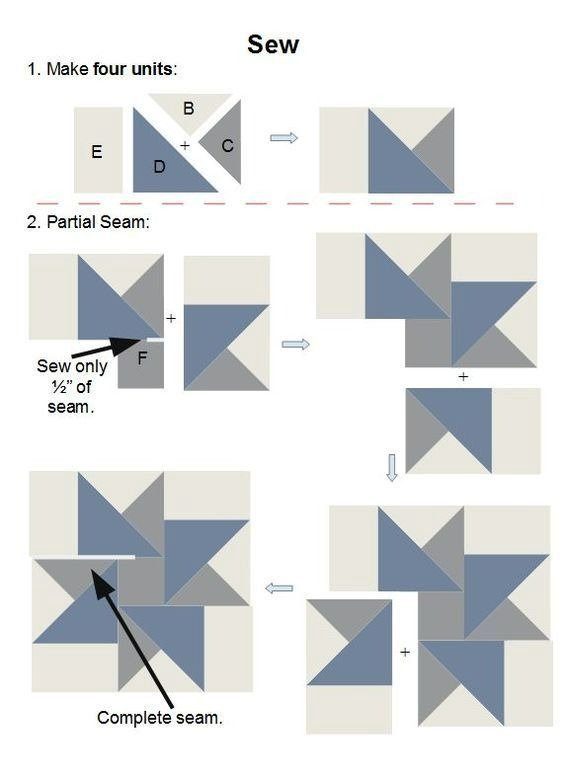
2. Step-by-Step Assembly of the Windmill Pattern
To begin the actual construction of your Double Windmill Block – Pattern, you must first create your Half-Square Triangle (HST) units. These are the building blocks of the blades. By sewing two contrasting squares together and cutting them diagonally, you create the diagonal lines necessary for the “spin.” It is helpful to make these units slightly oversized and then trim them down to the exact size required by your specific pattern instructions.
Once your HSTs are ready, the layout phase begins. Lay your pieces out on a design wall or a flat table to visualize the Double Windmill Block – Pattern before sewing. This is the moment to check that all your blades are “spinning” in the same direction. It is surprisingly easy to flip a triangle accidentally, which would break the visual flow of the quilt design. Take your time to ensure the primary and secondary colors are correctly nested.
The assembly usually happens in rows or quadrants. For the Double Windmill, sewing in four quadrants is often the most manageable method. You will join the top-left units, then the top-right, and so on. This modular sewing technique helps maintain control over the many small pieces involved. Each quadrant acts as a mini-version of the larger windmill structure, reinforcing the “double” theme inherent in the name.
After the quadrants are joined into halves, it is time for the “center seam.” This is the most critical juncture of the Double Windmill Block – Pattern. You want all eight points of fabric to meet perfectly in the center. Using a fine quilting pin to “nest” the seams will keep the fabric from shifting as it passes under the presser foot. Slowing down your sewing speed at this stage will significantly increase your piecing accuracy.
Once the block is fully joined, give it a final press. In the Double Windmill Block – Pattern, some quilters prefer to “spin the center seam” on the back. This involves picking a few stitches in the seam allowance to allow the seams to fan out in a circular motion, reducing the bulk at the very center. A flat block is a happy block, and this technique ensures your quilt top remains level and easy to quilt.
Consistency is your best friend when producing multiple units of the Double Windmill Block – Pattern. If you are making a full quilt, consider chain piecing—sewing the same components of multiple blocks one after another without cutting the thread. This not only saves time but also ensures that your tension and seam width remain uniform across the entire project, leading to a more cohesive finished quilt.
3. Fabric Selection and Color Theory for Windmill Designs
Selecting the right colors for your Double Windmill Block – Pattern can make the difference between a chaotic mess and a stunning masterpiece. The “windmill” effect relies entirely on visual contrast. Using a “Value Scale” (light, medium, and dark) is the best way to plan. Typically, a very light background allows the medium and dark “blades” to take center stage, emphasizing the geometric movement of the pattern.
Many modern quilters use solid fabrics to emphasize the clean lines of the Double Windmill Block – Pattern. Solids highlight the precision of the angles and make the secondary patterns—the shapes that form between blocks—more prominent. If you prefer prints, try to choose “low volume” prints for the background and “saturated prints” for the blades. Avoid using too many large-scale florals, as they can obscure the windmill’s silhouette.
The “Double” in Double Windmill Block – Pattern offers a unique opportunity for color play. You can treat the inner windmill as one color family (like warm oranges and yellows) and the outer windmill as another (like cool blues and greens). This creates a “glow” effect in the center of the block. Using complementary colors—those opposite each other on the color wheel—will result in the most vibrant and high-energy quilt aesthetic.
[Image showing a color wheel with complementary colors for quilting]
Don’t forget the importance of fabric grain. When cutting your triangles for the Double Windmill, be mindful of the “bias” (the diagonal direction of the weave). Fabric is stretchy on the bias, and if handled roughly, your windmill blades may become distorted. Using a bit of fabric starch before cutting can stiffen the fibers, making the Double Windmill Block – Pattern much easier to handle and preventing wonky edges.
For those who love a vintage look, “scrappy” versions of the Double Windmill Block – Pattern are incredibly popular. By using a consistent background fabric but varying the colors of the blades using scraps from your stash, you can create a “controlled chaos” look. The key to a successful scrappy quilt is maintaining a consistent “value” (darkness) for the blades so the windmill shape remains recognizable across the entire surface.
Finally, consider the “Scale” of your project. If you are making large Double Windmill blocks (e.g., 18 inches), you can afford to use bolder, larger prints. If you are working on a miniature quilt with 4-inch blocks, stick to solids or “tone-on-tone” fabrics. The Double Windmill Block – Pattern is versatile enough to handle both, provided you adjust your fabric choices to suit the physical size of the pieced units.
4. Advanced Tips for Finishing and Quilting the Windmill
Once your Double Windmill Block – Pattern units are all pieced and joined into a quilt top, the question of how to quilt it arises. Because the block has so many straight lines and sharp angles, you have two main choices: emphasize the geometry or soften it. Straight-line quilting (or “stitch-in-the-ditch”) reinforces the architectural feel of the windmill, making the lines look like they are vibrating with energy.
Conversely, using free-motion quilting to add swirls or feathers can create a beautiful contrast against the rigid angles of the Double Windmill Block – Pattern. Imaginative quilters often quilt “circles” over the windmills to play on the idea of a spinning fan. This juxtaposition of organic shapes and geometric piecing adds a sophisticated layer of “texture” that makes the final piece look like it belongs in a gallery.
The border design you choose can also enhance the Double Windmill Block – Pattern. A simple “solid border” acts like a frame, keeping the focus on the central movement. However, a “pieced border” using smaller versions of the windmill blades can extend the energy of the pattern all the way to the binding. This creates a sense of “infinity,” as if the windmills are spinning off the edges of the fabric.
When it comes to binding, consider a “striped fabric” cut on the bias. This creates a “barber pole” effect that complements the rotational energy of the Double Windmill Block – Pattern. If the quilt is intended for heavy use, a double-fold binding is the most durable choice. Ensure your thread color either matches the binding or is a neutral “grey or taupe” that blends into the background to keep the finish clean.
Batting choice is another “pro-tip” for the Double Windmill. If you want the “points” of your windmills to pop, use a high-loft polyester or wool batting. This creates more “dimension” and shadow. If you prefer a flat, modern, or antique look, a thin cotton or bamboo batting is better. The flatter the batting, the more the Double Windmill Block – Pattern looks like a crisp, printed graphic rather than a textured blanket.
Lastly, always document your work. The Double Windmill Block – Pattern is a complex achievement! Adding a quilt label to the back with the date, the pattern name, and your inspiration ensures that the history of your craft is preserved. Whether you give it as a gift or keep it as a family heirloom, this intricate pattern stands as a testament to your dedication to the art of traditional quilting.
FAQ – Frequently Asked Questions
What is the difference between a Pinwheel and a Double Windmill?
A standard pinwheel uses four triangles meeting at a center point. The Double Windmill Block – Pattern uses a more complex arrangement of eight or more triangles and squares to create a “layered” effect, making the design look like a windmill within a windmill.
Is this pattern suitable for beginners?
While a total novice might find the points challenging, an “ambitious beginner” can certainly handle it. The key is to practice Half-Square Triangles and focus on accurate seam allowances. Taking it slow and using starch will make the process much easier.
How much fabric do I need for a standard quilt?
This depends on the size of the blocks. Generally, for a throw-sized quilt using the Double Windmill Block – Pattern, you will need about 3 to 4 yards of background fabric and 1 to 2 yards of each “blade” color. Always buy an extra 1/4 yard for mistakes!
Can I use “Fat Quarters” for this pattern?
Yes! The Double Windmill Block – Pattern is very “Fat Quarter friendly.” Since the blades are made of smaller units, you can easily cut all your necessary pieces from a standard bundle of quilting cotton.
Why don’t my points match in the center?
This is usually caused by an inconsistent seam allowance or failing to trim your HSTs to a uniform size. Ensure you are using a dedicated 1/4-inch foot on your sewing machine and always press your seams before joining blocks.
What is the best way to quilt a Double Windmill?
“Echo quilting” (stitching a set distance away from the seams) is very popular as it emphasizes the windmill shape. Alternatively, a simple “diagonal grid” across the entire quilt top is an easy and effective way to secure the layers without distracting from the pattern design.
Conclusion
In this article, we explored the fascinating world of the Double Windmill Block – Pattern, a design that brings motion and complexity to any quilting project. We discussed the importance of color value and contrast, the technical necessity of precision cutting, and the step-by-step methods for assembling those tricky center points. From selecting the right batting to choosing a quilting style that complements the geometric blades, you now have the foundational knowledge to create a stunning textile masterpiece.
The Double Windmill Block – Pattern is more than just a series of triangles; it is a celebration of symmetry and artistic expression. By mastering the Half-Square Triangle and focusing on consistent seam allowances, you can turn simple fabric scraps into a dynamic visual experience.