
If you are looking for a delightful way to refresh your kitchen decor while reusing those beautiful fabric scraps you have been saving, learning how to make patchwork leaf potholders with this comprehensive tutorial is the perfect weekend project. Bringing the warm, cozy vibes of autumn into your home has never been easier or more practical than crafting your own quilted potholders. These charming, leaf-shaped kitchen accessories are not only incredibly functional for handling hot pans, but they also make heartfelt, handmade gifts for friends, family, or housewarming parties.
Quilting projects can sometimes feel intimidating if you are staring at a massive blanket pattern, but this project breaks everything down into simple, manageable steps. Quilting on a smaller scale allows you to experiment with different color combinations, master the art of sewing precise angles, and practice your binding techniques without the pressure of a massive time commitment. By blending the rustic charm of patchwork with a beautiful botanical shape, you will create an eye-catching piece that combines traditional craftsmanship with modern utility.
In this step-by-step guide, we will walk through the entire process from selecting the right heat-resistant materials to the final, satisfying stitches of your binding. Whether you are a seasoned quilter looking for a quick scrap-busting activity or a complete beginner eager to learn a new skill, this how to make patchwork leaf potholders tutorial will give you all the confidence you need. Grab your sewing machine, gather your favorite cotton remnants, and let’s dive into this fun and rewarding creative journey.
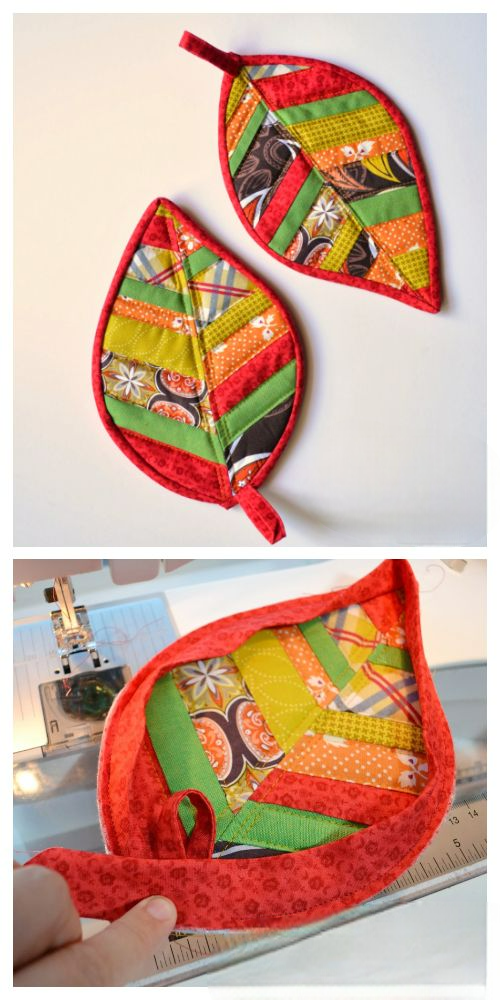
1. Gathering Your Materials and Preparing the Fabric
Before we jump into the actual sewing machine work, it is absolutely vital to gather the right materials to ensure your potholders are both beautiful and safe to use. When learning how to make patchwork leaf potholders, safety should always be your number one priority, which means selecting fabrics that can withstand high temperatures without melting. Always choose 100% cotton fabric for the outer patchwork shell, as synthetic fibers like polyester can easily melt when they come into contact with a scorching hot baking sheet.
Alongside your colorful cotton scraps, you will need a specialized heat-resistant batting, such as Insul-Bright, to act as the core thermal barrier. This material features hollow fibers and a metallic film that reflects heat back toward the source, keeping your hands completely safe from burns. However, because metal conducts heat, you must also pair this thermal barrier with a layer of traditional 100% cotton batting for maximum insulation. Combining these two layers guarantees that your beautiful patchwork leaf potholders will be completely functional in a busy kitchen environment.
For the visual design, look for scraps in rich, autumnal tones like deep terracotta, mustard yellow, forest green, and warm burgundy to capture that authentic leaf aesthetic. You can mix and match solids, subtle polka dots, plaids, and floral prints to give your patchwork a textured, eclectic look. Once you have curated your fabric selection, it is time to iron every single piece thoroughly, as crisp fabric makes accurate cutting infinitely easier.
In terms of essential tools, you will want a reliable rotary cutter, a self-healing cutting mat, and a clear quilting ruler to ensure straight edges. You will also need a printable leaf template, which you can easily draw yourself on sturdy cardboard or download from a trusted quilting blog. Finally, don’t forget high-quality cotton thread, sharp sewing pins or fabric clips, and a fabric marking pen that disappears with water or heat.
Pre-washing your fabrics is an optional but highly recommended step, especially if you plan on washing your finished kitchen accessories frequently in the future. Since cotton naturally shrinks when exposed to hot water and dryer heat, pre-washing prevents your beautiful leaf shape from warping or distorting during its first trip through the laundry. Once your fabric is dry and pressed flat, organize your scraps by color value so you can easily plan the layout of your patchwork blocks.
Investing a little bit of time into this preparation stage pays massive dividends once you start sewing your pieces together. Having your workspace organized and your materials properly selected ensures a smooth, frustration-free crafting experience from start to finish. Now that your cutting mat is laid out and your iron is hot, you are fully prepared to take the next step in this comprehensive how to make patchwork leaf potholders tutorial.
2. Cutting and Assembling the Patchwork Blocks
Now comes the incredibly creative part of learning how to make patchwork leaf potholders: designing and assembling your unique patchwork blocks. To create the classic leaf-like texture, we will be using a traditional quilting technique known as Half-Square Triangles, often abbreviated as HSTs. This simple yet versatile technique allows you to create sharp diagonal lines that perfectly mimic the natural veins running through a real leaf.
To start, use your rotary cutter to slice your cotton scraps into uniform squares, with a great starting dimension being 3 inches by 3 inches. Take two squares of contrasting colors—perhaps a vibrant orange and a muted beige—and place them right sides together so the edges align perfectly. Use your fabric marking pen to draw a light diagonal line on the back of the lighter fabric square, running exactly from one corner to the opposite corner.
Next, take this pair of squares to your sewing machine and sew two straight seams, each exactly a quarter-inch away from the diagonal line you just drew. Once you have stitched both sides, use your rotary cutter to slice directly along the drawn center line, separating the piece into two halves. Open up the newly formed squares, press the seams flat toward the darker fabric with your iron, and you will instantly have two perfect Half-Square Triangles.
Repeat this fun process with various color combinations until you have a beautiful collection of colorful HSTs and a few solid cotton squares to fill in the gaps. Lay these blocks out on your table, arranging them into a grid that loosely resembles the shape and internal vein structure of a leaf. Play around with the orientation of the triangles, rotating them until you achieve a visual flow that feels balanced, dynamic, and artistically pleasing to your eye.
Once you are completely satisfied with the layout of your grid, begin sewing the individual squares together row by row, using a strict quarter-inch seam allowance. After completing each row, press the seams of row one to the left, the seams of row two to the right, and alternate this pattern for every subsequent row. This smart technique, known as nesting seams, reduces fabric bulk dramatically and helps your sewing machine glide over the intersections perfectly.
Finally, stitch the completed rows together vertically to form your main patchwork fabric sheet, giving it one last thorough press with the iron. You now possess a vibrant, flat piece of custom-designed patchwork fabric that is ready to be transformed into a functional kitchen tool. This step highlights the true magic of this how to make patchwork leaf potholders tutorial, proving that simple shapes can combine to create stunning visual results.
3. Layering, Quilting, and Cutting the Leaf Shape
With your gorgeous patchwork top complete, you are now ready to construct the quilt sandwich, which is the crucial three-layer structure of your potholder. Lay your chosen backing fabric face down on your clean work surface, ensuring it is slightly larger than your main patchwork piece. On top of the backing fabric, place your layer of traditional 100% cotton batting, followed immediately by your layer of heat-resistant Insul-Bright thermal material.
Finally, place your pressed patchwork sheet right side up on top of the pile, smoothing out any wrinkles or air bubbles with your hands. To keep these four layers from shifting around while you sew, secure the entire sandwich using several curved quilting safety pins or a temporary fabric basting spray. Taking the extra time to properly secure your quilt sandwich prevents frustrating bunching, puckering, and uneven alignment during the machine quilting process.
Now it is time to bring your creation to life under the needle of your sewing machine by adding beautiful decorative quilting lines. A fantastic option for beginners is to use a walking foot attachment, which feeds all the layers through the machine at the exact same speed. You can sew straight lines directly next to your patchwork seams—a technique called ditch quilting—or create an organic, wavy pattern that mimics natural leaf veins.
The quilting lines serve a dual purpose: they add gorgeous depth and texture to the design, and they securely lock the insulation layers to the outer fabric. Once your quilting is complete, place your cardboard leaf template directly onto the quilted patchwork sandwich, aligning it so the best colors are featured prominently. Use your fabric marker to trace the elegant outline of the leaf carefully onto the fabric, making sure the shape is completely centered.
With a sharp pair of heavy-duty fabric shears, carefully cut along your drawn line through all the quilted layers at once. Take your time during this step, ensuring your cuts are smooth, clean, and follow the natural curves and points of your leaf template. To prevent the freshly cut edges from fraying or separating while you handle them, sew a quick stay-stitch all the way around the perimeter, about an eighth of an inch from the edge.
As you hold the cut-out shape in your hands, you will really see the hard work of this how to make patchwork leaf potholders tutorial coming together beautifully. The dense quilting, the rich colors, and the distinct leaf silhouette immediately give the piece a professional, artisan-crafted feel. All that is left now is to seal those raw edges and add the finishing touches that make it a durable, usable item.
4. Applying the Binding and Adding the Hanging Loop
The absolute final step in learning how to make patchwork leaf potholders is applying the fabric binding, which elegantly seals the raw edges and adds a polished frame. Because a leaf shape features organic curves and sharp points, using traditional straight-grain fabric binding strips can cause awkward puckering and bunching. Instead, it is highly recommended to use bias binding, which is fabric cut at a 45-degree angle, giving it a natural elasticity that stretches beautifully around curves.
You can easily create your own 2.5-inch wide bias strips from a coordinating fabric scrap, or purchase pre-made bias tape at your local craft store for convenience. Fold your binding strip completely in half lengthwise, right side facing outward, and use your hot iron to press a crisp crease along the entire length. Align the raw edges of your folded binding strip with the raw, stay-stitched edge on the front side of your beautiful quilted leaf.
Begin stitching the binding to the leaf using a quarter-inch seam allowance, starting along one of the straightest sections of the leaf’s lower edge. As you approach the curves, gently guide the flexible bias tape along the edge without pulling or stretching it too tightly, allowing its natural give to hug the shape. When you reach the sharp tip of the leaf, use a classic mitered corner technique by folding the tape upward and then back down to create a neat fold.
Before you finish sewing the binding all the way around, leave a generous 5-inch tail of fabric binding hanging free at the base of the leaf. This extra length will be folded over on itself and stitched down to create a incredibly convenient hanging loop for storage. A hanging loop allows you to display your gorgeous handiwork proudly on a kitchen wall hook, transforming utility into beautiful seasonal decor when not in use.
Once the front is entirely stitched down, flip the binding over the raw edge toward the backside of your potholder, securing it tightly with fabric clips. You can finish the back by carefully stitching in the ditch from the front side with your machine, or hand-stitch it using a blind slip-stitch for an invisibly clean look. Ensure that the back completely covers the initial machine stitches for a neat, professional, and seamless presentation from every angle.
Give your completed project one final, satisfying press with your iron to set all the stitches and flatten out the fabric beautifully. Congratulations, you have successfully combined creativity, safety, and sewing technique to craft an absolute masterpiece for your kitchen collection! This concludes the practical portion of our how to make patchwork leaf potholders tutorial, leaving you with a durable, stunning accessory that is ready for daily use.
Frequently Asked Questions (FAQ)
Can I use regular polyester batting for this potholder project?
No, it is highly recommended to avoid 100% polyester batting for potholders because polyester is essentially synthetic plastic and can melt when exposed to high heat. Always use a combination of 100% cotton batting and a dedicated heat-resistant material like Insul-Bright to ensure your hands are fully protected from burns.
What is the best size for a patchwork leaf potholder?
A great, functional size for a finished leaf potholder is roughly 8 to 10 inches in length and width. This size provides ample surface area to safely grip large baking sheets, hot cast-iron skillets, or heavy casserole dishes while still being easy to store.
How do I wash and care for my handmade patchwork potholders?
Since these are made from 100% cotton and high-quality batting, you can easily machine wash them on a gentle cycle with cold water and a mild detergent. To keep them looking pristine and prevent shrinkage, it is best to reshape them by hand and lay them flat to air dry.
Is bias tape absolutely necessary, or can I use straight binding?
Because a leaf template features prominent curves and sharp indents, bias tape is highly recommended for this specific project. Bias tape is cut on the diagonal grain of the fabric, which provides a natural stretch that allows it to lay completely flat around curves without warping.
Can a beginner with a basic sewing machine complete this tutorial?
Absolutely! This project only requires a basic straight stitch on your sewing machine. The patchwork layout utilizes basic squares and simple Half-Square Triangles, making it a fantastic, low-stress project for a beginner looking to improve their quilting and binding skills.
How many fabric scraps do I need to make one leaf potholder?
You don’t need much fabric at all, which makes this the ultimate scrap-busting project. A handful of fabric scraps measuring at least 3 inches square will give you plenty of material to construct the main patchwork sheet, allowing you to clear out your scrap bin effortlessly.
Conclusion
In this comprehensive step-by-step guide, we explored how to make patchwork leaf potholders from start to finish using an easy-to-follow tutorial. We covered the vital importance of selecting 100% cotton fabrics and heat-resistant batting for kitchen safety, creating beautiful Half-Square Triangles to mimic organic leaf veins, assembling a solid quilt sandwich, and applying flexible bias binding along with a functional hanging loop.