
Crochet Lily Flowers Pattern is one of the most elegant and rewarding floral crochet projects for crafters who enjoy creating timeless handmade decorations. A beautiful Crochet Lily Flowers Pattern combines delicate petals, realistic shaping, and carefully placed details to transform simple yarn into a stunning flower that never fades. Whether you are decorating your home, making bouquets, embellishing accessories, or creating thoughtful handmade gifts, this pattern offers endless creative possibilities while helping you improve your crochet skills.
Learning a Crochet Lily Flowers Pattern is also an excellent way to practice essential crochet techniques without feeling overwhelmed. Each petal is worked individually, allowing you to focus on maintaining even tension, shaping curves, and understanding stitch placement. Once the petals are complete, they are assembled into a realistic flower that closely resembles the elegance of a blooming lily. This project is suitable for adventurous beginners as well as experienced crocheters who appreciate detailed floral designs.
One of the greatest advantages of making a Crochet Lily Flowers Pattern is its versatility. You can create lilies in traditional white, soft lavender, vibrant pink, sunny yellow, or even artistic fantasy colors. The finished flowers can decorate hats, bags, blankets, wreaths, centerpieces, scarves, wall art, or gift packaging. Throughout this tutorial, you will learn the complete step-by-step process using standard U.S. crochet terminology, making it easy to follow regardless of your experience level.
Materials and Crochet Basics for the Crochet Lily Flowers Pattern
Before starting your Crochet Lily Flowers Pattern, gather all your materials. Medium-weight cotton yarn works beautifully because it provides structure while maintaining soft, clean stitch definition. Mercerized cotton is especially recommended if you want crisp petals that hold their shape well.
Choose a crochet hook slightly smaller than the yarn label recommends. For most medium-weight cotton yarns, a 2.75 mm to 3.5 mm hook produces firm stitches that help the petals maintain their elegant form. Keeping the stitches tight prevents gaps and gives the flower a professional appearance.
You will also need scissors, a yarn needle, floral wire if you want a wired stem, green floral tape, stuffing tweezers for shaping if necessary, and a small amount of yellow yarn or embroidery thread for the stamens.
The petals of this Crochet Lily Flowers Pattern primarily use chain stitches (ch), single crochet (sc), half double crochet (hdc), double crochet (dc), and slip stitches (sl st). These are basic stitches that most crocheters already know.
Maintaining consistent tension throughout every petal is important. Even tension ensures that all six petals match perfectly, resulting in a balanced flower once assembled.
Always count your stitches after every row. Careful stitch counting prevents uneven petals and makes assembly significantly easier later in the project.
Step-by-Step Crochet Lily Flowers Pattern Instructions
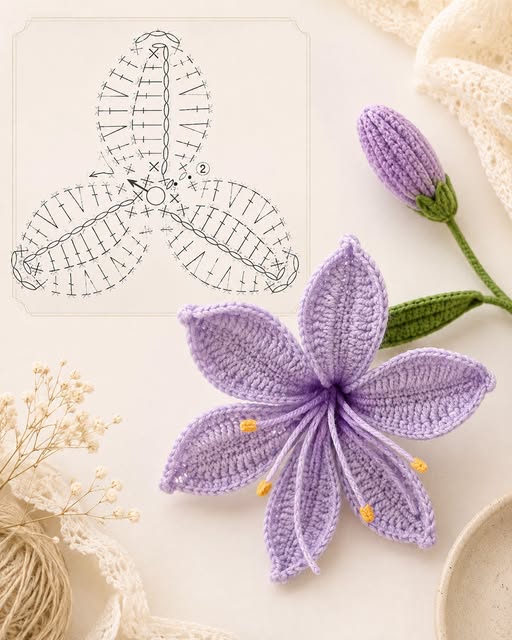
Begin the first petal by chaining 16. This foundation chain creates the center spine of the petal and determines its final length. Adjust the chain count if you prefer a slightly larger or smaller flower.
Work into the second chain from the hook using one single crochet. Continue with two half double crochets, six double crochets, two half double crochets, and finish with one single crochet near the tip. This gradual increase naturally forms the elegant pointed shape of the lily petal.
Without fastening off, continue crocheting along the opposite side of the foundation chain. Mirror the same stitch sequence to create perfect symmetry. Finish the petal with a slip stitch into the beginning stitch.
Chain one and crochet a final edging round using single crochet around the entire petal. At the very tip, work three single crochets into one stitch to emphasize the pointed shape. This finishing round also strengthens the edges.
Repeat this process until you have completed six identical petals. Place them side by side to compare their sizes. Minor adjustments can still be made by gently blocking them before assembly.
For the flower center, wrap several strands of yellow yarn around your fingers multiple times. Tie the center tightly, trim the loops, and brush the fibers slightly to create realistic stamens. Attach the stamens securely before arranging the petals around them.
Assembling the Crochet Lily Flower
Lay the six petals in a circular arrangement with their pointed tips facing outward. Slightly overlap the bases to mimic the natural structure of a real lily blossom.
Using the yarn needle and matching thread, sew the base of each petal together with small invisible stitches. Work slowly to ensure that every petal sits evenly around the center.
After joining all petals, gently bend each one outward using your fingers. This simple shaping technique instantly gives the flower a realistic three-dimensional appearance.
To create the stem, insert floral wire through the center of the flower. Wrap the wire tightly with green floral tape while adding small amounts of green yarn if desired for extra coverage.
Crochet one or two leaves by chaining approximately 20 stitches. Work single crochet, half double crochet, and double crochet toward the center before decreasing symmetrically back to the starting point. Sew the leaves securely onto the stem.
Lightly steam block the finished flower if your yarn allows. Blocking helps smooth the petals, improves symmetry, and enhances the professional finish of your completed Crochet Lily Flowers Pattern.
Creative Ideas, Customization Tips, and Finishing Techniques
A single Crochet Lily Flowers Pattern already looks elegant, but combining several flowers into a bouquet creates an even more impressive display. Mix multiple shades of lavender, white, cream, and soft pink for a realistic arrangement.
Experiment with different yarn textures. Cotton creates structured flowers, while bamboo yarn produces silky petals with gentle drape. Acrylic yarn can also be used for lightweight decorative projects.
Add subtle embroidery using darker thread near the center of each petal. These delicate details imitate the natural markings often found on real lilies and increase visual depth.
Attach finished lilies to headbands, handbags, pillow covers, table runners, wreaths, baby blankets, or gift boxes. Handmade crochet flowers instantly add charm to almost any project.
If making flowers for home décor, consider inserting flexible wire inside each petal before the edging round. Wired petals can be shaped repeatedly without losing their elegant curves.
Practice making multiple flowers with different sizes by adjusting the starting chain length. Smaller lilies work beautifully as appliqués, while larger versions become stunning table centerpieces or bouquet focal points.
Frequently Asked Questions
1. Is the Crochet Lily Flowers Pattern suitable for beginners?
Yes. Beginners who already know basic crochet stitches such as chain, single crochet, half double crochet, and double crochet can successfully complete this project with patience and careful stitch counting.
2. Which yarn works best for crochet lilies?
Mercerized cotton yarn is highly recommended because it provides excellent stitch definition, crisp edges, and durable petals that hold their shape over time.
3. How many petals does a crochet lily usually have?
Most realistic lily patterns feature six petals arranged evenly around the flower center, creating the classic lily appearance.
4. Can I wash crochet flowers?
Yes. Hand washing with mild detergent followed by gentle reshaping while damp is usually the safest method. Always allow the flowers to air dry completely.
5. How can I make the petals stiffer?
Using cotton yarn, tighter stitches, fabric stiffener, diluted craft glue, or inserting thin floral wire inside the edging all help the petals maintain their elegant shape.
6. What can I use crochet lilies for?
Crochet lilies are perfect for bouquets, home décor, wedding decorations, gifts, hats, scarves, handbags, blankets, wreaths, wall art, and seasonal centerpieces.
7. Can I make larger or smaller flowers?
Absolutely. Simply increase or decrease the starting chain length while maintaining proportional stitch placement throughout each petal.
8. Should I block the finished flower?
Blocking is highly recommended because it smooths the stitches, improves symmetry, and enhances the natural appearance of every petal.
Creating a Crochet Lily Flowers Pattern is a wonderful opportunity to combine creativity with traditional crochet techniques while producing a timeless floral decoration that will never wilt.
Throughout this guide, you learned how to select the appropriate materials, work each petal using standard U.S. crochet stitches, assemble the flower, create realistic stamens, add leaves and stems, and customize your design with professional finishing techniques. By practicing these methods, you can confidently create beautiful handmade lilies for bouquets, gifts, accessories, and home décor in a variety of colors and sizes. We hope this tutorial inspires your next crochet project.