
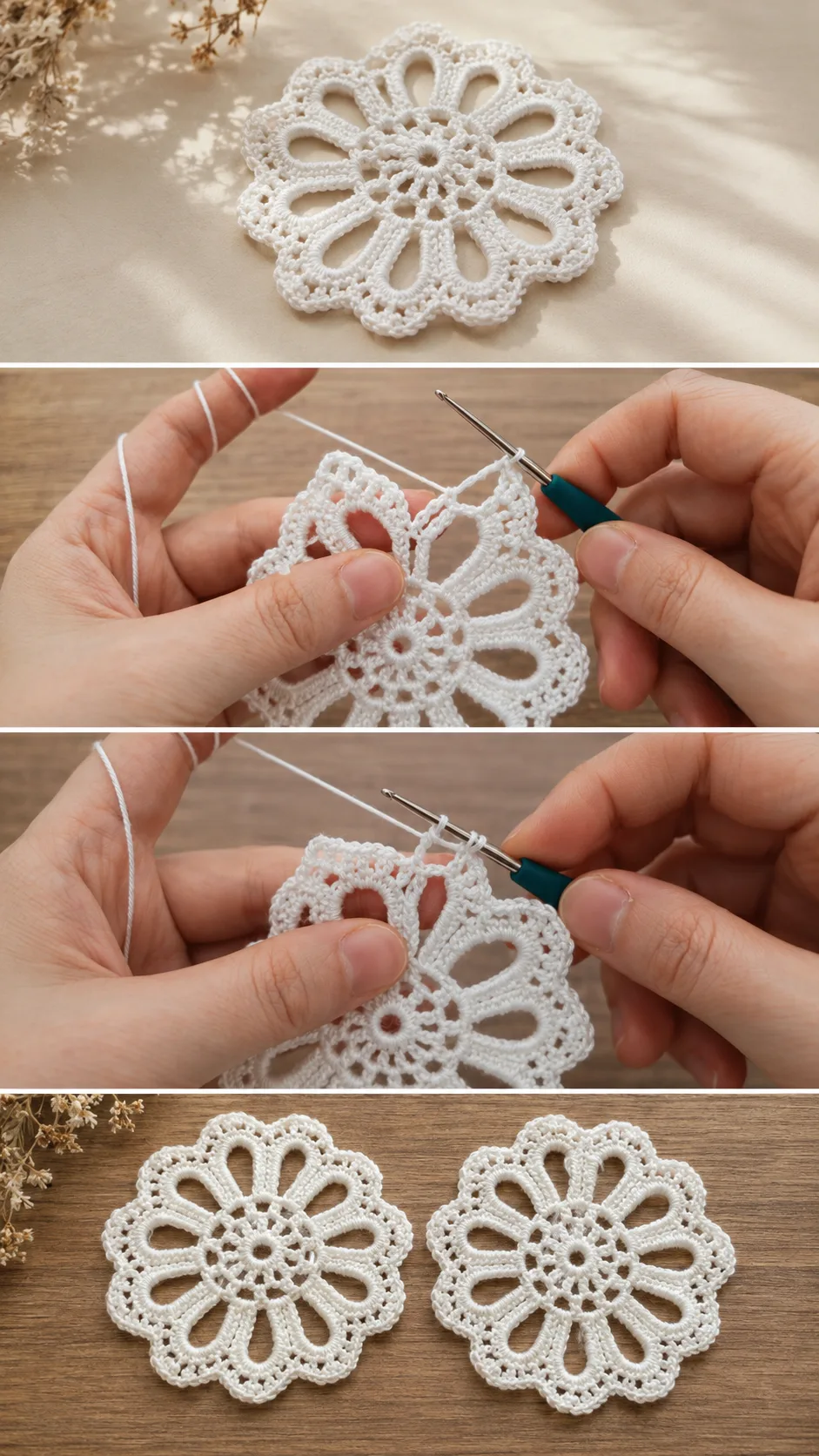
Crochet lace flower Pattern is a beautiful way to combine traditional crochet techniques with the light, elegant appearance of handmade lace. The flower shown in this project is built from the center outward, using open spaces, carefully shaped loops, and decorative edging to create a balanced circular motif. Instead of relying on complicated construction, the design develops round by round, making it possible to see the flower gradually take shape. The long open petals are especially attractive because they give the finished motif an airy appearance without making it feel fragile. Once you understand how the center, petal loops, and outer border relate to one another, this pattern becomes a rewarding project for practicing precision and consistent tension.
One of the most important characteristics of a Crochet lace flower Pattern is the relationship between solid stitches and open spaces. Crochet lace is not simply crochet made with thin thread; it is a technique in which chains, spaces, and strategically placed stitches become part of the visual design. For a flower similar to the one pictured, smooth cotton crochet thread is an excellent choice because it produces crisp stitch definition and helps the petals keep their shape. A small crochet hook appropriate for your chosen thread will create a neat fabric. You will also need scissors, a yarn or tapestry needle, and optionally blocking pins and a blocking mat for shaping the completed flower.
This crochet flower pattern can be used as a decorative motif, coaster-style accent, appliqué, table decoration, embellishment, or as part of a larger lace project. The finished size will depend heavily on thread thickness, hook size, and individual tension, so the instructions are best treated as a construction guide that can be adjusted when necessary. The flower in the reference design has a small circular center, an open decorative inner round, approximately twelve elongated petals, and a scalloped lace border. Maintaining the same number of repeated sections around every round is essential. Before beginning, become familiar with the U.S. crochet abbreviations ch (chain), sl st (slip stitch), sc (single crochet), hdc (half double crochet), dc (double crochet), and sp (space).
Materials, Crochet Stitches, and Preparing the Lace Flower Center
For this Crochet lace flower Pattern, choose a mercerized cotton crochet thread or another smooth lightweight cotton. Size 10 crochet thread works particularly well for a delicate lace appearance, although a slightly heavier cotton can be used if you want a larger motif. A hook around 1.5–2.0 mm is a practical starting point for fine thread. The exact combination is flexible because the goal is to produce stitches that look compact and defined without becoming excessively tight.
Begin the flower with a small center ring. Ch 6, then join the first chain with a sl st to form a circle. If you prefer a smaller central opening, you may use a magic ring instead. The traditional chain ring, however, complements the lace appearance and gives the center a clearly defined opening. Make sure the chain is not twisted before joining it.
For the first structural round, ch 1, then work 12 sc into the center ring. Join with a sl st into the first sc. These twelve stitches establish the repeat count for the flower. Because the pictured motif appears to have approximately twelve main petal sections, keeping twelve evenly spaced foundation points helps reproduce its symmetrical appearance.
Now begin creating the first openwork round. Ch 4, skip the next stitch, and work a dc into the following stitch. Continue with ch 2, dc in the next appropriate foundation point around the center, distributing the stitches evenly. The purpose of this round is to create small openings that separate the dense center from the larger decorative structure. Join neatly with a slip stitch.
The next round can strengthen these open spaces while creating attachment points for the petals. Work a combination such as sc into the chain space, ch 3, sc into the next chain space around. Keep every chain loop approximately the same height. If one loop is much tighter or looser than another, the petals added later may become uneven.
At this stage, place the motif flat on your work surface and inspect the center. It should resemble a small wheel or floral medallion, with evenly distributed openings surrounding the central ring. This foundation is more important than it may initially appear. A carefully made center allows the lace crochet flower to remain circular as increasingly larger rounds are added.
Step-by-Step Crochet Instructions for Creating the Long Lace Petals
The elongated petals are the defining feature of this Crochet lace flower Pattern. Each petal is formed from a relatively long chain loop anchored between two points of the inner flower. Begin at one attachment space and ch approximately 14–18, depending on your thread thickness and desired petal length. Anchor the chain into the next designated space with a sc or sl st. Repeat around until you have approximately twelve equal loops.
Before covering these loops with stitches, check their size carefully. Lay the work flat and gently spread the loops outward. They should look like narrow teardrops radiating from the center. If one loop is noticeably longer than the others, undo it and correct the chain count. Consistency during this stage produces a much more professional crochet lace motif.
To create the smooth edge around each loop, work closely spaced single crochet stitches around the chain. Rather than inserting the hook into every individual chain, you can crochet around the chain strand itself. Work enough sc to cover one side of the loop evenly, continue around the curved top, and work down the opposite side until you return to the base.
For a chain loop of about 16 chains, you may need approximately 24–32 single crochet stitches around the complete loop, although this varies according to tension. Do not force an exact stitch count if it causes the petal to buckle. The important goal is complete, smooth coverage. Push the stitches gently together as you work so that the chain foundation is hidden.
After completing one petal, anchor it securely into the next inner space and begin the following loop. Repeat the same process for all petals. Try to maintain the same working rhythm: make the chain loop, anchor it, cover it with sc, secure the base, and continue. This repeated construction makes the Crochet lace flower Pattern surprisingly relaxing once the technique becomes familiar.
When all petals are completed, the project should already resemble the main flower shown in the reference image. The petals should radiate outward without overlapping excessively. If they curl slightly, do not worry. Fine cotton crochet frequently curls during construction, and much of this irregularity disappears after the decorative border is completed and the motif is properly blocked.
Building the Decorative Scalloped Border Around the Crochet Flower
The outer border transforms the individual petals into one cohesive Crochet lace flower Pattern. Begin by joining your thread near the upper portion of one petal. Instead of simply crocheting around each petal independently, use chains and small stitch groups to connect neighboring petals. This creates the characteristic lace framework visible around the outside of the flower.
Work sc into a suitable stitch along the petal edge, ch 3, skip 2 stitches, sc into the next stitch. Repeat this sequence along the upper portion of the petal. These small chain arches create miniature open spaces. Adjust the number of skipped stitches when necessary so that the arches are distributed evenly rather than forcing the repeat into an unsuitable stitch count.
As you approach the rounded top of each petal, create a slightly fuller decorative section. For example, work sc, ch 3, sc into a central stitch or space. On the following round, these small arches can hold combinations of sc, hdc, dc, hdc, sc, forming subtle scallops. This produces the softly pointed floral border characteristic of decorative crochet lace.
Between two petals, keep the connecting stitches relatively compact. A sl st or sc placed near the valley between petals will pull the edging inward and emphasize the separate petal shapes. Then begin increasing the height of the border again as you move toward the top of the next petal. This alternating inward-and-outward shaping creates a naturally scalloped silhouette.
For an additional finishing round, work into each chain-3 space with sc, ch 2, sc, or use 3 sc if you prefer a denser border. At the highest point of each petal, a tiny picot can be added by working ch 3, sl st into the first chain. Picots are optional, but they add the delicate points commonly associated with vintage-inspired crochet lace flowers.
Continue the border around all twelve petals without changing your tension. When you reach the beginning, join with a neat sl st. Cut the thread while leaving a tail of several inches, pull the tail through the final loop, and weave it securely into the back of the stitches. Avoid making large knots because they can remain visible through fine lace.
Finishing, Blocking, Adjustments, and Ways to Use the Crochet Lace Flower
Blocking is one of the most valuable finishing steps for this Crochet lace flower Pattern. Even carefully crocheted petals may appear slightly irregular immediately after the hook work is finished. Light blocking opens the lace spaces, aligns the petals, and gives the flower its polished circular shape. This step can dramatically improve the finished appearance.
If you are using cotton thread, lightly dampen the motif with clean water and gently press out excess moisture without twisting it. Place the flower on a blocking mat or another pin-friendly surface. Arrange all petals evenly around the center and pin the outer points into position. Measure from the center to several petal tips to help maintain symmetry.
Allow the flower to dry completely before removing the pins. For decorative pieces that need extra firmness, a light fabric-safe stiffening method can be used, but it is optional. If the flower will be attached to fabric or another flexible crochet piece, leaving it naturally soft is usually preferable. Always consider the intended use before adding any stiffening treatment.
To make the flower larger, use heavier yarn and a corresponding hook rather than dramatically changing every stitch count. To create a miniature version, choose finer thread and a smaller hook. This approach preserves the proportions of the crochet lace flower pattern while allowing the final diameter to change naturally.
Color also changes the character of the project. White and ivory produce a classic lace appearance similar to the reference image, while soft pastels can create a romantic floral effect. Bright colors produce a more contemporary motif, and alternating colors between the center, petals, and border can highlight the construction. When changing colors, weave each tail carefully so it does not show through the open lace.
Completed flowers can be used individually or combined into larger handmade projects. Several motifs can be joined to create decorative runners, table pieces, wall decorations, or textile accents. A single Crochet lace flower Pattern can also become an appliqué for a handmade bag, cushion, garment, or fabric accessory. When using the motif on an item that will be washed frequently, secure every thread tail particularly well.
FAQ About the Crochet Lace Flower Pattern
Is this Crochet lace flower Pattern suitable for beginners?
It is best suited to confident beginners or intermediate crocheters. The individual stitches are relatively basic, but maintaining twelve equal petals, controlling fine thread, and building a symmetrical lace border requires patience. Beginners who already know chains, single crochet, double crochet, and slip stitches should be able to practice the design successfully.
What yarn is best for a crochet lace flower?
Mercerized cotton crochet thread is an excellent option because it offers strong stitch definition and creates crisp lace. Size 10 thread is commonly useful for decorative motifs. Lightweight cotton yarn can also be used when a larger and softer flower is preferred.
What crochet hook should I use?
For fine crochet thread, a hook around 1.5–2.0 mm is a useful starting range. Always compare the hook with the recommendations for your particular thread and adjust according to your tension. If the stitches are extremely difficult to work, move up slightly in hook size.
Why are my crochet petals curling?
Curling often occurs when too many stitches are packed around a chain loop or when your tension is very tight. Mild curling is usually corrected during blocking. Severe curling may require removing a few stitches from the petal edging or using a slightly larger hook.
How can I make all the petals the same size?
Count the same number of chains for every foundation loop and try to maintain consistent tension. You can also compare each newly completed petal with the previous one before moving forward. Correcting a petal immediately is easier than discovering a size difference after the entire border has been completed.
Can I make the flower without blocking it?
Yes, but blocking is strongly recommended for lace crochet. It opens the spaces and makes the circular shape more symmetrical. A flower that appears slightly uneven directly from the hook can look substantially more refined after careful blocking.
Can I use regular yarn instead of crochet thread?
Yes. Regular cotton yarn will create a larger and thicker version of the motif. Choose a hook appropriate for the yarn and remember that heavier yarn will make the open spaces and petals look more substantial than traditional lace.
How many petals should the flower have?
The reference-inspired design uses approximately twelve elongated petals. Maintaining an even number of attachment points in the center is essential if you want all twelve petals to be distributed evenly around the flower.
What does “sp” mean in crochet instructions?
Sp means space. It usually refers to an opening created by chains in a previous round. Instead of inserting your hook directly into a stitch, you insert it into the open chain space and work the specified stitches there.
What is the difference between a chain space and a chain loop?
A chain space is usually a small opening created by one or more chains between stitches. A chain loop can be much larger and may become a structural element itself. In this Crochet lace flower Pattern, long chain loops form the foundations of the elongated petals.
How do I prevent the flower from becoming wavy?
Waviness generally indicates that the outer rounds contain too much fabric for the circumference. Reduce the number of stitches or decorative arches slightly and avoid excessively loose tension. Blocking can correct mild waviness, but strong ruffling usually requires adjusting the stitch count.
Can these flowers be joined together?
Yes. You can sew completed motifs together with matching thread or join them through selected outer chain spaces. When creating a larger arrangement, place the flowers flat before joining so you can decide where the connections will produce the most balanced layout.
Conclusion
The Crochet lace flower Pattern combines a compact circular center, openwork construction, elongated chain-loop petals, and a delicate scalloped border to create an elegant handmade motif. The project begins with a simple ring and gradually expands through carefully repeated rounds, demonstrating how basic crochet stitches can produce surprisingly intricate lace when they are arranged thoughtfully.The most important lessons are maintaining an even repeat count, keeping the petal chains consistent, covering each loop smoothly with single crochet, and carefully shaping the decorative outer border. Once the crochet work is complete, blocking helps reveal the full beauty of the pattern by opening the lace and aligning the petals.
Whether you make the flower in traditional white cotton, a soft pastel shade, or a brighter modern color, the same construction can be adapted to many decorative projects. Practice the motif a few times and you can also experiment with different thread weights, hook sizes, border details, and finished dimensions while keeping the recognizable floral structure.I hope this Crochet lace flower Pattern helps you understand not only how to recreate this delicate flower, but also how lace motifs are constructed from simple crochet techniques. If you make your own version, leave your sincere opinion about the pattern and share any suggestions or variations you would like to try. Your ideas can inspire new ways to use this beautiful crochet lace flower in future handmade projects.