
The Crochet Granny Square – Tutorial is arguably the most iconic and timeless gateway into the world of fiber arts, capturing the hearts of makers for generations. Whether you are a absolute beginner picking up a hook for the very first time or a seasoned crafter looking to unwind with a classic project, learning how to master this versatile motif opens up a universe of creative possibilities. From cozy heirloom blankets and stylish cardigans to trendy tote bags and modern home decor, the humble square serves as the fundamental building block for countless stunning designs.
When you dive into a Crochet Granny Square – Tutorial, you are not just learning a repetitive stitch pattern; you are connecting with a rich crafting tradition that celebrates sustainability, color play, and mindful creativity. The beauty of this technique lies in its incredible simplicity and adaptability, allowing you to mix vibrant yarn scraps or stick to a minimalist monochromatic palette depending on your personal aesthetic. Because these motifs are worked from the center outward in small, manageable rounds, they make the perfect portable project to take with you anywhere you go.
In this comprehensive guide, we will break down the entire process step-by-step, ensuring you understand the essential stitches, structural anatomy, and clever assembly methods needed to achieve flawless results. By focusing on proper tension, seamless color transitions, and correct hook placement, you will quickly gain the confidence to transform basic yarn into beautiful, structured squares. Grab your favorite yarn, find a comfortable seat, and let’s explore the ultimate Crochet Granny Square – Tutorial designed to elevate your stitching journey today.
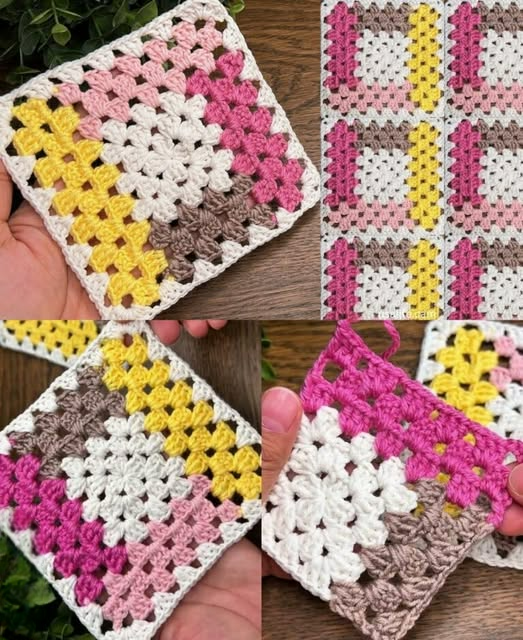
1. Essential Materials and Tools for Your First Project
Before you begin chaining your first stitches, gathering the right supplies is crucial for a smooth and enjoyable crafting experience. For beginners diving into a Crochet Granny Square – Tutorial, a medium-weight yarn—specifically worsted weight yarn or Aran yarn (category 4)—is highly recommended because it provides excellent stitch visibility and is easy to handle. Choosing light or bright yarn colors will make it much easier to see the spaces where your hook needs to go, preventing common mistakes.
Alongside your yarn, you will need a matching crochet hook, typically a 5.0 mm (H-8) crochet hook or a 5.5 mm hook, which pairs perfectly with worsted weight fibers. It is wise to check your yarn label for the manufacturer’s recommended hook size, but don’t be afraid to adjust if your stitches feel too tight or too loose. A comfortable ergonomic hook can make a world of difference, preventing hand fatigue during long, relaxing stitching sessions.
In addition to your primary tools, a few inexpensive notions will make your crafting process significantly easier and more professional. You will want to keep a pair of sharp yarn scissors close at hand for clean yarn cuts when changing colors or finishing your work. A sturdy tapestry needle (or yarn needle) with a large eye is absolutely essential for weaving in those loose ends securely so your hard work doesn’t unravel.
Many crafters also find that using locking stitch markers helps them keep track of the beginning of each round, especially when working in complex color patterns. Another fantastic optional tool is a granny square blocking board, which helps stretch and shape your finished motifs into perfectly uniform squares. Having these materials organized beforehand ensures that you can focus entirely on the rhythm of your stitches without interruptions.
When selecting your fiber type, 100% acrylic yarn or a premium cotton blend is an excellent, budget-friendly choice for practicing your first few motifs. Acrylic is incredibly forgiving, holds its shape well through washes, and comes in an endless array of vibrant colorways to spark your imagination. As you gain more experience, you can experiment with luxurious wools, bamboo blends, or even upcycled fibers to create different textures.
Ultimately, investing a little time into selecting comfortable tools sets the foundation for a successful and satisfying crochet hobby. Remember that everyone’s tension is unique, so your first square might look a bit wavy or tight, which is completely normal. Keep your tools nearby, stay patient with yourself, and prepare to master the fundamental stitches that make up this beautiful vintage art form.
2. Step-by-Step Guide to Stitching the Classic Motif
To kick off your Crochet Granny Square – Tutorial, you will begin by creating a center ring, which can be done using a slip knot followed by a base of four chains joined with a slip stitch. Alternatively, many modern crafters prefer starting with a magic ring (or magic circle) because it allows you to pull the center completely closed, leaving no visible hole in the middle of your work. Whichever method you choose, this initial ring serves as the foundation where all your first-round stitches will be anchored.
Once your center ring is established, you will chain three, which counts as your very first double crochet stitch (dc). Next, work two more double crochet stitches directly into the center ring, forming your first granny stitch cluster, which is simply a group of three double crochets worked into the same space. Chain two to create your very first corner space, which provides the necessary angling to turn your circle into a distinct square shape.
Repeat the pattern by working three more double crochets into the ring, followed by another chain-two space to form your second corner. You will repeat this sequence until you have a total of four distinct yarn clusters and four chain-two corner spaces inside the ring. To close this first foundational round, insert your hook into the top of your initial chain-three space and secure it with a neat slip stitch.
For the second round, you will slip stitch across the tops of the stitches until you reach the nearest corner space, or simply chain three if you are continuing with the same color. In this round, you will work a corner sequence consisting of three double crochets, a chain of two, and three more double crochets all within that same corner space. This doubling of clusters is what expands the square’s dimensions while maintaining its clean, geometric four-corner structure.
As you move between corners on larger rounds, you will typically chain one to span the distance over the clusters from the previous row. Each straight side will receive a single cluster of three double crochets in the side spaces, while every corner will always receive the classic double-cluster formula separated by two chains. This predictable, rhythmic repetition is exactly why the classic granny square is loved worldwide for its soothing, meditative qualities.
When you reach the end of round two, join again with a slip stitch to complete the circuit, noticing how your project is expanding evenly. You can continue adding as many rounds as you desire using this exact formula, turning your tiny motif into a giant, cozy blanket if you choose. The key to success here is maintaining consistent yarn tension so that all four sides of your square remain beautifully uniform and flat.
3. Mastering Seamless Color Changes and Custom Variations
One of the most exciting aspects of practicing a Crochet Granny Square – Tutorial is the ability to experiment with endless color combinations and unique design variations. To change colors seamlessly at the end of a round, cut your working yarn leaving a six-inch tail, pull the loop through, and use an invisible join for a flawless edge. Then, simply tie a slip knot with your new color and join it directly into any corner space with a slip stitch to begin the next round fresh.
If you prefer to minimize the number of loose ends you have to weave in later, you can try the clever technique of carrying yarn colors along your rows. This involves crocheting right over the unused strand of yarn along the top of your stitches, hiding it inside the clusters until you need to switch back. However, using a fresh yarn join for each round often yields the crispest, most defined color contrast between the concentric squares.
Beyond the traditional design, you can explore beautiful modern twists like the solid granny square, which eliminates the open spaces for a denser, warmer fabric. This variation is highly sought after for items like winter blankets, structured bags, and warm garments where you want minimal gaps between your stitches. You can also experiment with sunburst granny squares or flower centers to give your projects a whimsical, romantic vintage aesthetic.
For a retro look, try pairing bright, contrasting neon colors with a solid black or deep navy border on the final round of each piece. This makes the interior shades pop dramatically, mimicking the beloved vintage crochet blankets that were wildly popular throughout the 1970s. Alternatively, using soft pastel gradients or ombré yarns can create a soothing, modern watercolor effect across your finished fabric without requiring constant yarn switching.
Don’t limit yourself to just squares either; the same basic cluster logic can be adapted to create stunning crochet triangles, hexagons, and even pentagons. Understanding how to manipulate the corners allows you to build unique geometric shapes that assemble into breathtaking, complex patchwork layouts. The skills you develop while mastering the basic square layout will serve as the exact blueprint for these advanced structural shapes.
As you explore these custom variations, keeping a dedicated crochet journal or using a digital app to sketch out your color layouts can be incredibly helpful. Laying out your individual motifs before joining them allows you to balance the colors evenly across the entire surface of your final project. Give yourself permission to play with texture, weight, and color theory to turn a basic pattern into a true reflection of your personal style.
4. Professional Joining Methods and Blocking Techniques
Once you have crocheted an impressive collection of motifs following your Crochet Granny Square – Tutorial, it is time to assemble them into a gorgeous finished project. The method you choose to connect your pieces can drastically alter the final look, drape, and durability of your item. For a completely flat, practically invisible seam, the mattress stitch join using a tapestry needle is an exceptional choice that gives a beautifully tailored finish.
If you prefer using your hook for assembly, the single crochet join creates a raised, decorative ridge between the squares that adds wonderful texture and a modern grid-like appearance. Another popular approach is the slip stitch join, which is worked through either both loops or just the back loops for a flatter, more subtle raised detail. For a faster and incredibly fun option, the join-as-you-go method allows you to attach new squares during their final round of stitching.
Before or after joining your pieces together, performing a process called blocking your crochet is highly recommended to achieve professional, boutique-quality results. Blocking involves gently wetting your crochet pieces or applying targeted steam, then pinning them onto a foam board to dry in precise measurements. This simple step relaxes the yarn fibers, opens up the lacework beautifully, and ensures that every single square is exactly the same size.
To wet-block your squares, submerge them in cool water mixed with a gentle, no-rinse wool wash for about fifteen minutes without twisting or wringing the fabric. Gently press the excess moisture out by rolling the motifs inside a clean, dry towel before transferring them to your pinned blocking mats. If you are working with premium acrylic yarn, using a handheld garment steamer is incredibly effective, but ensure the hot metal never touches the fiber directly.
Once your assembled piece is fully blocked and joined, finishing it off with a cohesive, beautiful crochet border will tie the entire design together perfectly. A simple border of a few rows of single crochet, a classic shell stitch, or a repeating granny cluster row provides a polished frame for your work. This final touch also helps disguise any minor imperfections along the outer edges of your perimeter squares.
Taking the time to execute these finishing steps with care transforms a simple hobby project into an impressive, long-lasting piece of art you can be proud of. Properly blocked and securely joined items withstand the test of time, frequent washing, and daily use with absolute ease. Celebrate the journey of turning loose skeins of yarn into a structured, beautiful masterpiece that can be cherished for many years to come.
Frequently Asked Questions (FAQ)
How many granny squares do I need to make a full-sized blanket?
The exact number depends entirely on the size of your individual squares and the dimensions of the blanket you wish to create. For instance, if your motifs are 6 inches by 6 inches, a standard throw blanket measuring 50 inches by 60 inches would require approximately 80 individual squares. It is always a great idea to crochet a single practice piece first, measure it accurately, and map out your layout on graph paper before starting.
Why is my granny square curling at the corners or twisting?
Curling or twisting usually happens due to uneven yarn tension or pulling your corner chain stitches a bit too tightly during your rounds. If your piece is distorting, try switching to a slightly larger crochet hook size or consciously relaxing your stitching hand to loosen the tension. Additionally, performing a proper blocking process at the very end will easily flatten out minor curls and give your square its perfect shape.
Can I mix different yarn brands or fiber types in the same project?
While you absolutely can mix brands, it is highly recommended to stick to the same yarn weight (such as worsted weight) and similar fiber contents across all your squares. Mixing a stretchy wool with a stiff cotton or a thin acrylic can cause your squares to wash unevenly and distort the shape of your final blanket. If you do mix brands, check the yardage-to-weight ratio on the labels to ensure the thicknesses match up closely.
What is the best way to hide and secure all the loose yarn tails?
The most secure method is to weave your yarn tails through the dense centers of your double crochet clusters using a blunt tapestry needle. Pass the yarn through in one direction for about an inch, turn around and go back in the opposite direction, and then do it a third time to lock it in place. This clever three-way weaving technique ensures your ends will never pop out or unravel, even after multiple cycles through a washing machine.
Is the granny square pattern suitable for absolute beginners who just started?
Yes, it is one of the best projects for beginners because it relies on basic foundational stitches like the chain stitch, slip stitch, and double crochet. Because it is worked in the round, you do not have to worry about maintaining perfectly straight side edges like you do when working in rows. Once you memorize the simple rhythm of the corner clusters, the pattern becomes second nature and builds confidence rapidly.
Conclusion
In this ultimate guide, we explored the wonderful world of fiber arts through a detailed Crochet Granny Square – Tutorial, covering everything from selecting the ideal worsted weight yarn and ergonomic hooks to mastering the fundamental double crochet clusters.
We examined how to effortlessly transition between contrasting colors, troubleshoot tension issues, and implement professional finishing steps like wet blocking and the mattress stitch join. With these core skills in your crafting toolkit, you are now fully equipped to design, assemble, and border your very own gorgeous blankets, garments, and home accessories.