
Fan Stitch in Crochet- Tutorial is one of the most rewarding techniques a crafter can master, offering a blend of vintage charm and modern sophistication to any handmade project. Whether you are looking to create a delicate baby blanket, a breezy summer shawl, or an intricate border for a pillowcase, learning the Fan Stitch in Crochet- Tutorial will significantly expand your creative repertoire. This stitch pattern is beloved for its repetitive rhythm and the stunning visual impact it creates with relatively simple movements.
The beauty of the Fan Stitch in Crochet- Tutorial lies in its versatility across different yarn weights and textures. By grouping multiple stitches—typically double crochets—into a single base stitch, you create a flared shape that resembles an open folding fan. Mastering this technique allows you to play with negative space and density, making it a staple for anyone serious about advancing their crochet skills and understanding how to manipulate fabric drape.
As we dive into this Fan Stitch in Crochet- Tutorial, you will find that the key to success is maintaining consistent tension and a clear count of your stitches. It is a fantastic way to practice your double crochet (dc) and chain stitches (ch) while producing a fabric that looks much more complex than it actually is. In the following sections, we will break down the essential components, from the basic setup to the finishing touches that make your work look professional and polished.
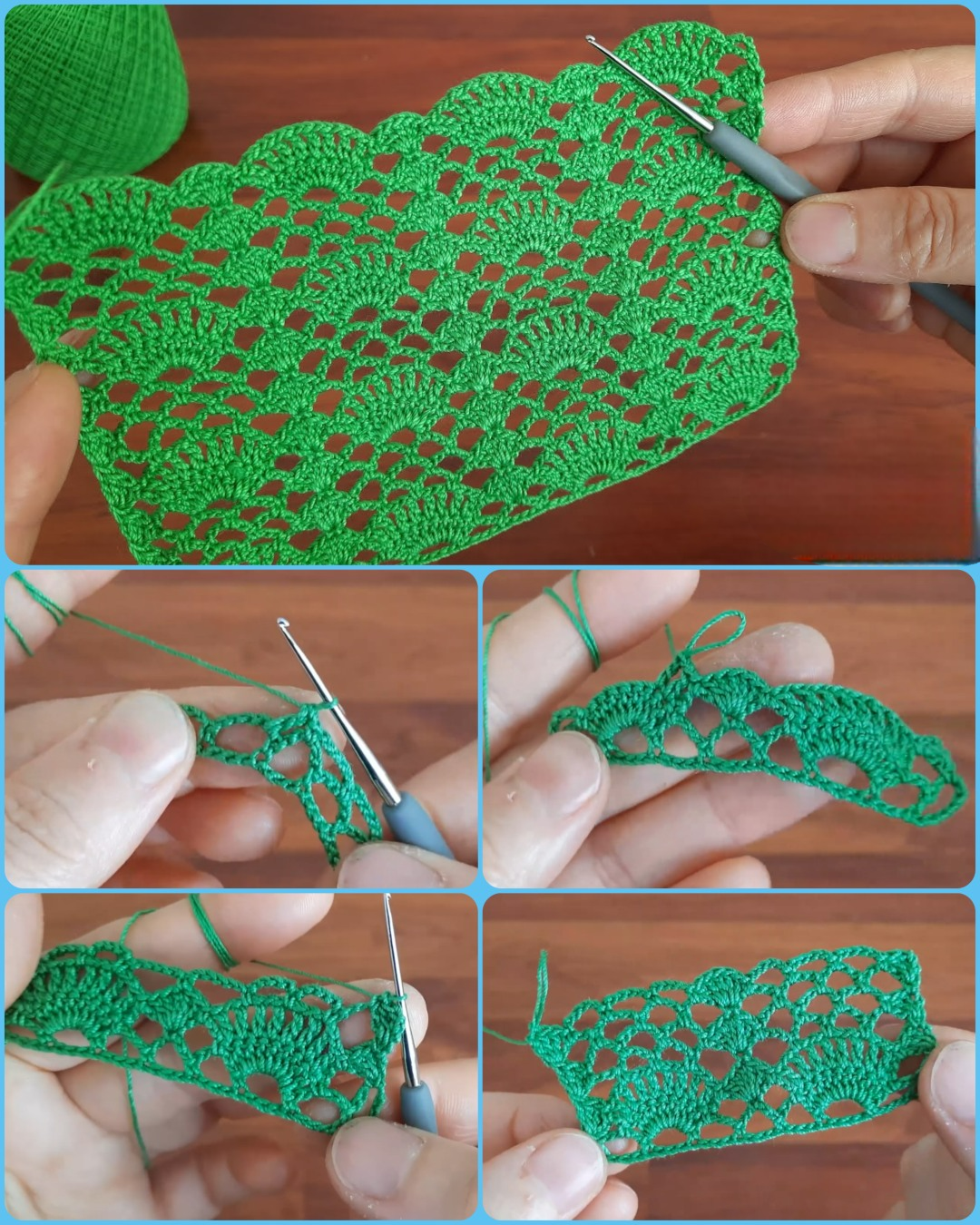
1. Understanding the Foundation Row for Fan Stitch in Crochet- Tutorial
To begin your journey with the Fan Stitch in Crochet- Tutorial, you must first master the foundation chain and the initial row setup. Most fan patterns require a specific multiple of stitches, often a multiple of 6 plus 1, to ensure the fans are symmetrical across the width of your work. Starting with a clean foundation chain is vital because it supports the weight of the decorative fans that will sit directly above it.
In this Fan Stitch in Crochet- Tutorial, the first row usually consists of basic stitches like single crochet (sc) to provide a sturdy edge. This base row acts as the “anchor” for your fans, ensuring they don’t pull the fabric out of shape as you build height. If your foundation is too tight, your fans will look cramped; if it is too loose, the bottom edge of your project may flare uncontrollably.
The term turning chain is also crucial here, as it provides the necessary height to move from the foundation to the first row of fans. For a standard fan made of double crochets, you will typically need a turning chain of three. This allows the edges of your work to remain straight and prevents the “pulling” sensation that can distort the overall silhouette of your crochet project.
Properly identifying the stitch loops is the next step in ensuring your fans are placed correctly. You will be skipping a specific number of stitches—usually two or three—before worked multiple stitches into the next loop to create that iconic fan shape. This skipping technique is what creates the “valley” between the “peaks” of your fans, giving the fabric its wavy, rhythmic appearance.
As you work through the Fan Stitch in Crochet- Tutorial, remember that the “fan” itself is simply a collection of stitches worked into a single point. This concentration of stitches naturally forces the yarn to spread outward. Understanding this physical mechanic helps you visualize the pattern before you even insert your hook, making it easier to spot mistakes in your stitch count early on.
Finally, always double-check your gauge before committing to a large piece. While the fan stitch is decorative, its open nature can lead to a stretchier fabric than you might expect. Practicing a small swatch using the Fan Stitch in Crochet- Tutorial method will help you determine if you need to adjust your hook size to achieve the desired drape and size for your final garment or accessory.
2. Executing the Core Fan Pattern and Shell Variations
The heart of the Fan Stitch in Crochet- Tutorial is the actual formation of the fan, which is often referred to interchangeably as a shell stitch. A standard fan is created by working 5, 7, or even 9 double crochets into the same stitch or space. The more stitches you add to the cluster, the more dramatic and rounded the fan will appear, allowing for endless customization based on your personal style.
In a traditional Fan Stitch in Crochet- Tutorial, these clusters are separated by a single crochet or a skipped space to define the shape. This contrast between the dense cluster of the fan and the narrow “anchor” stitch is what creates the scalloped edge. Mastering the transition between the high double crochets and the low single crochets is the secret to a professional-looking stitch definition.
You might also encounter open fans, which incorporate small chain spaces between the double crochets within the fan itself. This variation is perfect for lace-work, as it creates a lighter, airier fabric that is ideal for spring clothing. Learning both the solid and open versions within this Fan Stitch in Crochet- Tutorial will give you the flexibility to tackle various patterns and designs.
The concept of stacking fans is another technique you will use frequently. In some patterns, you will work a new fan directly into the center stitch of the fan from the previous row. In other variations, you will work the fans in the “valleys” (the single crochets) of the row below. This offset fan arrangement creates a brick-like pattern that is incredibly popular for blankets and scarves.
Using a stitch marker can be incredibly helpful when you are first learning the Fan Stitch in Crochet- Tutorial. Placing a marker in the center stitch of each fan helps you identify exactly where to place your hook in the following row. This prevents the common mistake of shifting the pattern to one side, which can result in a diagonal or slanted piece of fabric rather than a rectangular one.
To finish a row of fans, you will usually end with a half-fan or a single turning stitch to keep the edges flush. This ensures that the sides of your blanket or shawl are straight, making it much easier to add a crochet border later on. Paying attention to these edge details is a hallmark of an experienced crafter following a detailed Fan Stitch in Crochet- Tutorial.
3. Advanced Color Changes and Texture Enhancements
One of the most exciting ways to utilize the Fan Stitch in Crochet- Tutorial is by incorporating color changes. By switching colors every one or two rows, you can highlight the wavy nature of the stitch. Using a contrasting color for the fans and a neutral color for the anchor rows creates a “stained glass” effect that is visually stunning and highly marketable for those who sell their handmade crafts.
The technique of carrying yarn or changing colors at the end of a row is a skill that complements the Fan Stitch in Crochet- Tutorial perfectly. To keep your work neat, always complete the last pull-through of the final stitch in the row with the new color. This creates a seamless transition that doesn’t disrupt the flow of the scalloped pattern, keeping your fans looking crisp and vibrant.
To add even more depth, you can try working the fans in the back loop only (BLO). This creates a ribbed texture at the base of each fan, adding a three-dimensional element to your work. Integrating texture into your Fan Stitch in Crochet- Tutorial turns a simple flat fabric into a tactile masterpiece, perfect for cozy items like winter hats or textured decorative throws.
Another professional tip involves using variegated yarn versus solid colors. Variegated yarn can sometimes “hide” the beautiful geometry of the fan stitch, whereas solid colors emphasize the shadows and shapes. In this Fan Stitch in Crochet- Tutorial, we recommend using solid or long-gradient yarns to truly showcase the repetitive elegance of the fans without the colors becoming too “busy.”
If you want to create a more luxurious feel, consider using mercerized cotton or a silk blend. These yarns have a slight sheen that catches the light on the curves of the fans, elevating the Fan Stitch in Crochet- Tutorial from a simple hobby project to a high-end fashion piece. The way the light hits the peaks and valleys of the stitch is one of the most satisfying aspects of this pattern.
Don’t forget the importance of blocking your finished work. Because the fan stitch involves clusters of stitches, the fabric can sometimes bunch up or pull inwards. Steam or wet blocking your finished crochet item allows the fans to open up fully and lay flat, revealing the true beauty of the Fan Stitch in Crochet- Tutorial and ensuring your dimensions are accurate and professional.
4. Troubleshooting Common Issues in Fan Stitch Projects
Even with a comprehensive Fan Stitch in Crochet- Tutorial, beginners often run into the issue of “curling” edges. This usually happens if your tension is too tight on the double crochets or if you are skipping too many stitches between the fans. If you notice your work starting to look like a bowl, try using a larger hook or loosening your grip on the yarn to allow the fans to spread naturally.
Another common hurdle is losing the stitch count at the ends of the rows. It is very easy to accidentally add or subtract a stitch when turning, which leads to a lopsided project. In this Fan Stitch in Crochet- Tutorial, we emphasize counting your fans at the end of every row. If you started with 10 fans, you should always have 10 fans (or the equivalent in half-fans) as you progress upward.
Gaps in the fabric are sometimes a concern for those who want a warmer, denser blanket. If the holes between your fans are too large, you can modify the Fan Stitch in Crochet- Tutorial by reducing the number of skipped stitches or adding a chain-1 between the fans to bridge the gap more subtly. Customizing the pattern to suit your needs is part of the joy of freeform crochet.
Sometimes, the fans may appear “floppy” or lack definition. This often occurs when using a yarn that is too soft or lacks structure, like certain unmercerized cottons or loose-twist acrylics. To fix this, try working your double crochets slightly tighter or choosing a yarn with better stitch definition so that each “leaf” of the fan stands out clearly against the background.
If you find that your rows are becoming progressively narrower, you are likely missing the very last stitch of the row. In the Fan Stitch in Crochet- Tutorial, the top of the turning chain acts as a stitch. You must work your final anchor stitch into the third chain of that turning chain to keep the height consistent and the edges perfectly vertical throughout the entire piece.
Lastly, yarn tangles can be a nuisance when working with the large clusters required for fans. Since you are pulling a lot of yarn for each fan, ensure your yarn cake or skein is flowing freely. A smooth workflow is essential for maintaining the rhythmic “flow” that makes the Fan Stitch in Crochet- Tutorial so meditative and enjoyable for crafters of all skill levels.
FAQ: Frequently Asked Questions about Fan Stitch in Crochet
How many chains do I need to start a fan stitch project?
Most fan stitch patterns require a multiple of 6 + 1. However, this can vary depending on the specific Fan Stitch in Crochet- Tutorial you are following. Always check the pattern’s “multiples” note before starting your foundation chain.
Can a beginner learn the fan stitch?
Absolutely! If you know how to do a single crochet and a double crochet, you have all the skills needed. The fan stitch is simply a specific arrangement of these basic moves. It’s a great “level-up” project for someone who has mastered the basics.
Is the fan stitch the same as the shell stitch?
They are very similar! In the world of crochet terminology, “shell” is a broad term for multiple stitches in one space, while “fan” often specifically refers to those that create a wider, more spread-out appearance. Most people use the terms interchangeably.
How much yarn does the fan stitch use?
Because the fans are made of clusters of double crochets, this stitch does use slightly more yarn than a flat rows of single crochets. It is often considered a “yarn eater,” so make sure you have an extra skein on hand for larger projects.
What is the best yarn for the fan stitch?
A smooth, medium-weight (worsted) yarn is best for beginners. It allows you to see the stitch definition clearly. Once you are comfortable, cotton and bamboo yarns are excellent choices because they emphasize the drape and elegance of the fans.
Can I use the fan stitch for a border?
Yes! The fan stitch makes one of the most beautiful crochet borders. You can apply it to the edge of a plain blanket to give it an instant upgrade and a professional, scalloped finish.
Conclusion
Mastering the Fan Stitch in Crochet- Tutorial is a landmark achievement for any crochet enthusiast. We have explored everything from the fundamental foundation row and the execution of the core shell patterns to advanced color techniques and troubleshooting common mistakes.
By understanding the relationship between the clusters and the anchor stitches, you can now create intricate, beautiful fabrics that boast both texture and elegance. This stitch is more than just a pattern; it is a versatile tool that you can adapt for almost any project, whether it’s a cozy winter accessory or a light, airy summer garment.