
Heart-shaped Fabric Coasters – Tutorial is a delightful project that combines practicality with a touch of handmade charm, perfect for adding a cozy atmosphere to your coffee table. Whether you are looking for a thoughtful gift for a loved one or simply want to use up those beautiful fabric scraps in your craft room, mastering this Heart-shaped Fabric Coasters – Tutorial will give you a quick and satisfying win. These coasters are not only adorable but also highly functional, protecting your surfaces from heat and moisture while showcasing your unique style and sewing skills.
The beauty of a Heart-shaped Fabric Coasters – Tutorial lies in its simplicity and the endless possibilities for customization through color and texture. By choosing different patterns, such as vintage florals, modern geometrics, or classic solids, you can create a set of fabric coasters that perfectly matches your home decor or the specific theme of a holiday. In this guide, we will focus on a “turn-and-topstitch” method, which is ideal for beginners because it hides the raw edges inside, resulting in a professional, clean finish that looks like it came from a high-end boutique.
As you embark on this Heart-shaped Fabric Coasters – Tutorial, you will find that the process is as much about the journey as the destination. Sewing small items requires a bit of precision, especially when navigating the curves of a heart, but it is a fantastic way to improve your machine handling and detail work. We will walk through the essential materials, the cutting process, the sewing steps, and the finishing touches that make these quilted coasters stand out. Prepare your sewing machine, gather your favorite cotton prints, and let’s get started on creating something beautiful and useful.
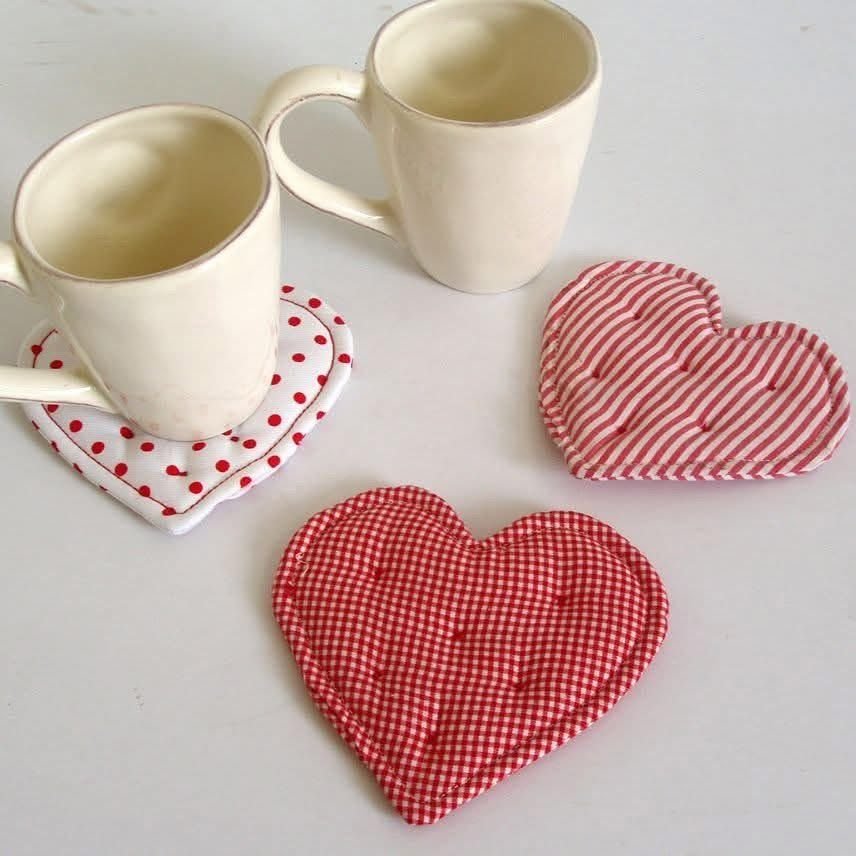
1. Gathering Materials for Your Heart-shaped Fabric Coasters – Tutorial
To begin your Heart-shaped Fabric Coasters – Tutorial, you first need to select high-quality 100% cotton fabric. Cotton is the preferred choice for coasters because it is heat-resistant and absorbent, which is exactly what you need when placing a hot mug of tea or a cold glass of water on a surface. You will need two squares of fabric for each coaster—one for the front and one for the back—allowing you to make them reversible or use a contrasting solid for a pop of color.
The secret to a sturdy and heat-protective result in this Heart-shaped Fabric Coasters – Tutorial is the internal layering. You will need a layer of cotton batting or insulated fleece (like Insul-Bright) to sit between the fabric pieces. This padding provides the necessary thickness to soak up condensation and prevents heat from transferring directly to your wooden furniture. Using a natural fiber batting ensures that the coaster remains breathable and easy to wash in the future.
Beyond the fabric, your Heart-shaped Fabric Coasters – Tutorial requires basic sewing notions that you likely already have in your stash. A sharp pair of fabric shears or a rotary cutter and mat are essential for getting those crisp heart shapes. You will also need matching all-purpose polyester or cotton thread, a fabric marking pen to trace your template, and plenty of fine sewing pins or wonder clips to keep the layers from shifting during the stitching process.
A crucial component of any successful Heart-shaped Fabric Coasters – Tutorial is the heart template itself. You can easily draw one by folding a piece of paper in half and cutting a half-heart shape, ensuring both sides are perfectly symmetrical. For a standard coaster, aim for a size that is roughly 5 inches wide and 5 inches tall. This provides a generous surface area that can accommodate even the largest oversized mugs or small bowls.
Preparation is key, so before you start sewing, make sure to pre-wash and iron your fabrics. Since coasters will inevitably get wet or need washing, pre-shrinking the cotton prevents the coaster from warping or puckering after its first trip through the laundry. A crisp, pressed fabric is also much easier to trace and cut accurately, which is vital when you are trying to maintain the iconic symmetry required for this Heart-shaped Fabric Coasters – Tutorial.
Lastly, ensure your sewing machine is fitted with a fresh universal needle (size 80/12 or 90/14). Because you will be sewing through two layers of fabric and a layer of batting, you need a needle that can handle the bulk without skipping stitches. Having a walking foot is also a great advantage for this Heart-shaped Fabric Coasters – Tutorial, as it helps feed all the layers through the machine evenly, preventing the “bunching” that often happens with small, multi-layered projects.
2. Cutting and Preparing the Layers for Sewing
In this stage of the Heart-shaped Fabric Coasters – Tutorial, you will transform your raw materials into the recognizable heart shapes. Lay your exterior fabric and backing fabric right sides together, and then place your batting underneath them. By pinning your heart template onto this “sandwich,” you can cut through all three layers at once. This ensures that your front, back, and padding are perfectly aligned, which is a major time-saver and improves the overall accuracy of your handmade coasters.
When cutting out your shapes for the Heart-shaped Fabric Coasters – Tutorial, remember to add a small seam allowance if your template represents the finished size. Most sewists prefer a 1/4 inch seam allowance for small projects. If you find cutting curves difficult, try using a smaller rotary cutter (28mm), as it navigates the tight turns of the heart’s “cleavage” and the bottom point much more smoothly than a large cutter or traditional scissors.
Once your pieces are cut, it is helpful to mark a small “opening” on one of the straight-ish sides of the heart. This is the gap you will leave unsewn so that you can turn the coaster right side out later. In a professional Heart-shaped Fabric Coasters – Tutorial, we recommend placing this opening away from the bottom point or the top center dip, as these areas are high-stress points and are harder to close neatly with a hidden stitch.
Pinning is your best friend in this Heart-shaped Fabric Coasters – Tutorial. Because batting can be slippery against cotton, use more pins than you think you need around the curves. If the layers shift even slightly, the heart might come out looking lopsided or distorted. Keeping everything anchored firmly will allow you to focus entirely on guiding the fabric through the machine’s presser foot with confidence and precision.
Before you move to the machine, take a moment to organize your sets. If you are making a set of four or six coasters, keeping the matching front and back pieces together will prevent confusion. This Heart-shaped Fabric Coasters – Tutorial is a great “assembly line” project; you can do all the tracing first, then all the cutting, and then all the pinning. This systematic approach makes the process faster and ensures consistent quality across the entire set.
A final tip for this preparation phase is to double-check that your fabric prints are oriented correctly. If you are using a directional print (like little houses or animals that have a “top” and “bottom”), make sure the heart is placed so the design isn’t upside down. A well-placed pattern in your Heart-shaped Fabric Coasters – Tutorial shows attention to detail and elevates the project from a simple craft to a piece of professional-grade textile art.
3. Stitching the Curves and Turning the Fabric
The sewing phase of the Heart-shaped Fabric Coasters – Tutorial requires a slow and steady hand. Start stitching at your marked opening, backstitching at the beginning to secure the thread. As you approach the curves of the heart, shorten your stitch length slightly. This makes the curve smoother and stronger. When you reach the “V” at the top of the heart or the point at the bottom, stop with the needle down, lift the presser foot, and pivot the fabric for a sharp, clean angle.
Navigating the deep curve of the heart is often the most challenging part of any Heart-shaped Fabric Coasters – Tutorial. To get a perfect shape, don’t try to sew the curve in one fast motion. Instead, “pulse” your foot pedal and move the fabric incrementally. This prevents the heart from looking “blocky” or jagged. Precision here is what makes your sewing project look high-end and ensures the coaster sits flat on the table without any weird bumps.
After you finish sewing around the perimeter—remembering to leave that 2-inch gap—you must perform some “seam surgery.” Use your scissors to clip small notches into the seam allowance around the curves. Be very careful not to cut through your stitches! Clipping the curves allows the fabric to expand and sit smoothly when turned. In this Heart-shaped Fabric Coasters – Tutorial, you should also trim the excess fabric at the bottom point to reduce bulk and ensure a sharp tip.
Now comes the exciting part of the Heart-shaped Fabric Coasters – Tutorial: turning the coaster right side out. Reach through the opening and gently pull the fabric through. It might look like a crumpled mess at first, but don’t worry. Use a point turner or a blunt chopstick to push out the edges and the bottom point. Take your time with this step to ensure the heart shape is fully defined and the curves are pushed out to their maximum extent.
Once the coaster is turned, it will likely look a bit puffy and distorted. This is where the iron becomes your most important tool in the Heart-shaped Fabric Coasters – Tutorial. Press the coaster flat, making sure the seam is rolled right to the edge. Fold the raw edges of your opening inward so they align with the rest of the heart’s shape and press them firmly. A good steam press at this stage makes the coaster look significantly more professional and prepares it for the final topstitching.
The final structural step in this Heart-shaped Fabric Coasters – Tutorial is closing that opening. You can do this by hand using a ladder stitch for a completely invisible finish, or you can simply wait until the topstitching phase. Most modern makers prefer the topstitching method because it is faster and adds a decorative element. Regardless of which you choose, ensuring that the opening is securely closed is vital for the coaster’s durability and longevity.
4. Finishing Touches and Decorative Topstitching
Topstitching is the “secret sauce” of this Heart-shaped Fabric Coasters – Tutorial. By sewing a final line of stitches about 1/8 inch from the edge all the way around the heart, you accomplish two things: you close the turning gap and you flatten the edges so the coaster sits perfectly under a glass. You can use a matching thread for a subtle look or a contrasting thread to make the heart shape “pop.” This decorative border is a hallmark of a high-quality Heart-shaped Fabric Coaster.
If you want to take your Heart-shaped Fabric Coasters – Tutorial a step further, consider adding some simple quilting lines. You can sew a smaller heart shape inside the first one, or create a grid pattern across the surface. This not only looks beautiful but also anchors the batting in place, ensuring it doesn’t shift or bunch up when the coaster is tossed in the washing machine. It gives the coaster that classic “quilted” texture that feels so premium.
For those who enjoy a bit of extra flair, this Heart-shaped Fabric Coasters – Tutorial can be customized with embellishments. You could add a small loop of ribbon at the top center so the coasters can be hung up when not in use, or even add a bit of embroidery, like a monogram or a small flower. Just remember that the surface needs to stay relatively flat so that glasses don’t tip over, so avoid bulky buttons or thick beads on the main body.
Another advanced variation for this Heart-shaped Fabric Coasters – Tutorial involves using scrappy quilting techniques. Instead of two solid pieces of fabric, you could sew several thin strips of fabric together to create a “striped” fabric sheet before cutting out your heart. This is a fantastic way to use up even the tiniest bits of your favorite designer fabrics and results in a truly one-of-a-kind piece of functional art.
Once your topstitching and decorations are complete, give the coasters one final press with a hot iron. This “sets” the stitches into the fabric and gives the coaster a crisp, finished look. If you are giving these as a gift, stacking them and tying them with a bit of twine or a fabric scrap is a lovely way to present the results of your Heart-shaped Fabric Coasters – Tutorial. They are small enough to fit into an envelope, making them a perfect “happy mail” surprise.
Think about the long-term care of your creations as you finish this Heart-shaped Fabric Coasters – Tutorial. Since they are made of cotton and batting, they are fully machine washable. Advise the recipient to wash them on a gentle cycle and lay them flat to dry to maintain that perfect heart shape. Now that you’ve mastered the technique, you can whip up a whole set in an afternoon, proving that DIY home decor can be both beautiful and incredibly efficient to produce.
FAQ – Frequently Asked Questions
1. Can I use felt instead of cotton for this Heart-shaped Fabric Coasters – Tutorial?
Yes, you can! Felt is a great alternative because it doesn’t fray, which means you could even do an “exposed seam” version where you just stitch the layers together without turning them inside out. However, keep in mind that felt is less absorbent than cotton and might pill over time with heavy use.
2. What size should my heart template be?
A good size for a fabric coaster is usually between 4.5 and 5.5 inches at the widest point. This ensures there is enough space for the base of a standard mug plus a little “wiggle room” so the heart shape is still visible while the drink is sitting on it.
3. Do I really need batting for these coasters?
While you can make them without batting, they will be very thin and won’t protect your surfaces as well from heat or moisture. If you don’t have batting, you could use a layer of old denim or several layers of flannel to provide that necessary thickness and absorbency mentioned in the Heart-shaped Fabric Coasters – Tutorial.
4. How do I make the bottom point look sharp and not rounded?
The trick is all in the “trim and pivot.” When sewing, make sure to pivot exactly at the point. Before turning the fabric right side out, trim the seam allowance at the point very close to the stitches (but not through them). When you turn it, use a point turner to gently push the fabric into place.
5. Are these coasters heat-proof?
If you use 100% cotton fabric and batting, they are very heat-resistant and perfect for hot coffee or tea. However, if you use synthetic fabrics like polyester, they could potentially melt if a very hot pot was placed on them. For standard mugs, cotton is perfectly safe.
Conclusion
This Heart-shaped Fabric Coasters – Tutorial has guided you through the entire process of creating charming, functional, and durable home accessories.
From selecting the right cotton fabrics and insulated batting to mastering the art of sewing curves and the final decorative topstitching, you now have the skills to create a professional-looking set of coasters. We’ve explored how to prepare your layers, how to navigate the tricky “V” and point of the heart, and how to add those personal finishing touches that make handmade items so special.