
Fall Leaves Quilt Block – Tutorial is the perfect project to bring the warm, cozy colors of autumn into your home through the beautiful art of quilting. As the crisp autumn breeze starts to blow and the trees transform into a stunning canvas of amber, rust, and gold, crafters everywhere feel the undeniable urge to head to their sewing rooms. This comprehensive guide will walk you through every step needed to create a gorgeous autumnal masterpiece that captures the very essence of the season. Whether you want to make a cozy seasonal throw, a festive table runner, or a stunning full-sized bed cover, learning this specific pattern will elevate your quilting skills and bring a touch of nature indoors.
Quilting during the autumn months has a unique charm that connects us to tradition while allowing our modern creativity to shine. A fall leaves quilt block tutorial offers the ideal balance of geometric precision and organic beauty, making it an incredibly rewarding project for quilters of all experience levels. By using simple piecing techniques like Half-Square Triangles and strategic fabric placement, you can easily replicate the intricate, delicate shape of a falling autumn leaf. This project is also fantastic for using up your fabric stash, allowing you to mix and match different prints to mimic the natural variation found in a real forest during October.
In this detailed guide, we are going to break down the entire process from start to finish so you can approach your sewing machine with total confidence. We will cover everything from selecting the right fabric palette and cutting your pieces accurately to assembling the blocks and troubleshooting common piecing mistakes. By focusing on smart sewing habits, accurate seam allowances, and proper pressing techniques, you will ensure your points match up beautifully every single time. Grab your favorite warm beverage, turn on your iron, and let’s dive deep into this wonderful quilting journey together.
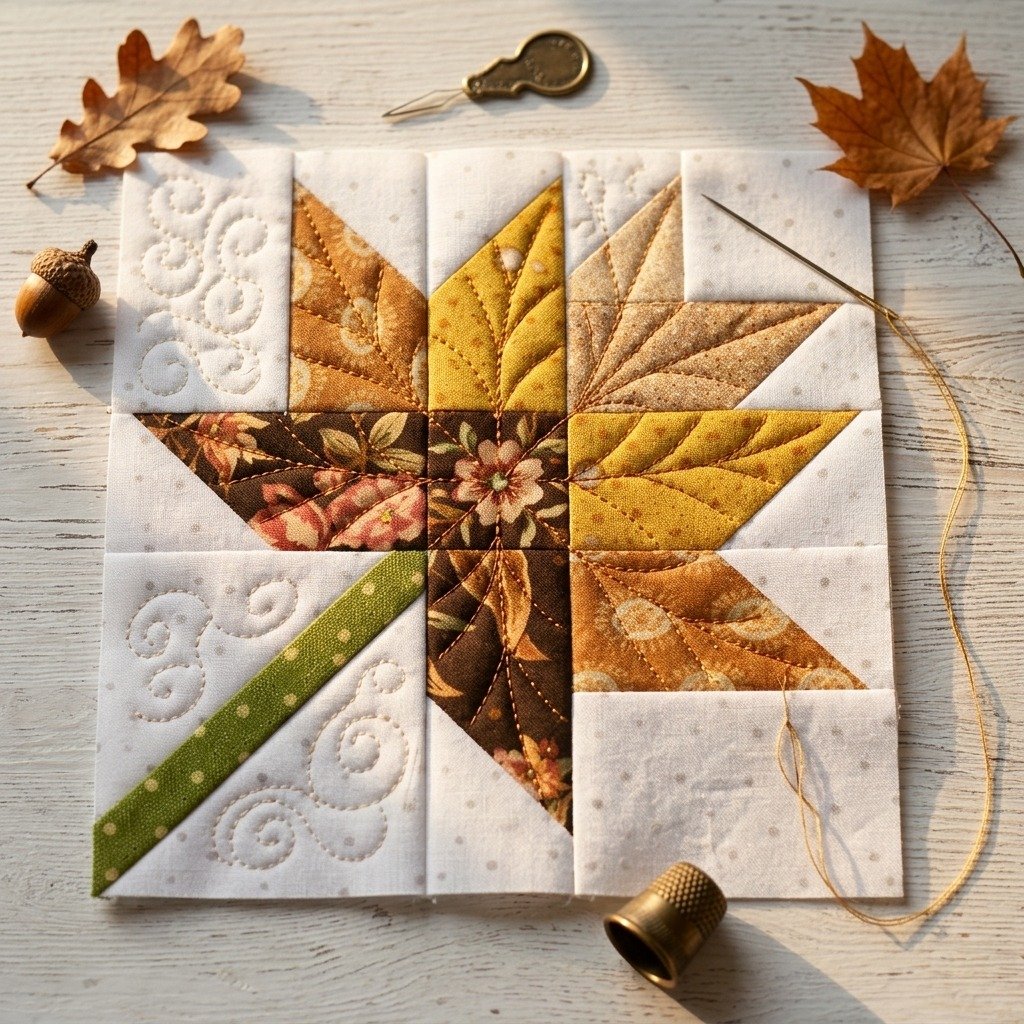
1. Choosing the Perfect Fabrics for Your Autumn Leaf Project
Selecting the right color palette is the most exciting part of starting a new project. To make your fall leaves quilt block tutorial truly pop, you want to choose colors that evoke the deep warmth of the autumn season. Think about rich terracotta oranges, deep burgundy reds, golden mustard yellows, and earthy moss greens for your leaf fabrics.
Contrast is absolutely essential when you are choosing fabrics for a geometric nature pattern. If your background fabric is too similar in value to your leaf fabrics, your beautiful patchwork design will get completely lost. A crisp white, a soft cream, or a modern low-volume print works beautifully as a high-contrast background that makes the vibrant autumn colors stand out.
Don’t be afraid to mix different fabric textures and prints to give your quilt block more depth and visual interest. Combining small-scale florals, subtle tonal batiks, and classic plaid prints can mimic the organic, imperfect beauty of real autumn foliage. Look through your fabric scraps first, as this pattern is incredibly scrap-friendly and looks amazing with a scrappy look.
Before you make a single cut into your precious fabric, it is highly recommended to press all of your yardage with a good steam iron. Wrinkly fabric leads to inaccurate cutting and piecing, which can throw off your entire block alignment later on. Taking a few extra minutes to prep your fabric now will save you a lot of frustration during the assembly process.
When estimating your fabric yardage, it is always a smart idea to buy just a little bit of extra material to account for any accidental miscuts. Having a quarter-yard of extra background or leaf fabric gives you peace of mind while working at your cutting mat. Plus, any leftover fabric can easily be saved for a matching quilted pillow or a scrappy binding later.
Organizing your fabrics before you begin sewing will keep your creative workspace calm and highly efficient. Group your leaf fabrics by color family and keep your background pieces in a separate pile next to your cutting station. This simple organization step helps you visualize how the colors will interact across the entire layout of your quilted project.
2. Step-by-Step Cutting Instructions and Accurate Measurements
Accurate cutting is the secret foundation of any successful quilting project, especially when dealing with angled pieces. For this fall leaves quilt block tutorial, you will need a rotary cutter with a sharp blade, a self-healing cutting mat, and a reliable acrylic quilting ruler. Take your time during this stage to ensure every single cut is perfectly straight.
To create one standard twelve-inch finished leaf block, you will need to cut a mixture of squares and rectangles from both your leaf fabric and background fabric. Specifically, you will need to cut several larger squares that will be transformed into Half-Square Triangles, which form the angled tips of the autumn leaf.
From your main leaf fabric, cut three squares measuring four inches for the Half-Square Triangles, and four squares measuring three and a half inches for the solid body sections. You will also need to cut one small square for the leaf stem area, depending on the specific stem technique you prefer to use for your block.
From your chosen background fabric, cut three squares measuring four inches to match your leaf fabric squares for the half-square triangle units. Additionally, cut four squares measuring three and a half inches for the outer corners, and two rectangles measuring three and a half inches by six and a half inches to frame the stem.
Always measure twice and cut once to prevent wasting your favorite fabrics during the preparation phase. Alignment is key, so make sure the grid lines on your acrylic ruler match up perfectly with the straight grain of your fabric before applying pressure with your rotary cutter. Keep your fingers safely away from the sharp blade at all times.
Once all of your pieces are neatly cut, stack them systematically by size and color on a small design tray near your sewing machine. Keeping your cut pieces organized prevents you from accidentally sewing the wrong size square into the wrong section of the pattern. Now that your pieces are ready, we can move on to the sewing machine.
3. Assembling the Half-Square Triangles and Leaf Body
The magic of the fall leaves quilt block tutorial comes together through the creation of Half-Square Triangles, often abbreviated as HSTs in the quilting community. To make these units, take a four-inch background square and draw a straight diagonal line from one corner to the opposite corner on the wrong side of the fabric using a fabric marker.
Place the marked background square directly on top of a four-inch leaf fabric square, ensuring the right sides of the fabrics are facing each other. Pin the two layers securely in place so they don’t shift while sewing. You will repeat this simple marking and layering process for all three sets of your four-inch squares.
Take the layered squares to your sewing machine and sew a precise quarter-inch seam down both sides of the drawn diagonal line. Using a standard quilting foot helps maintain an accurate seam allowance, which is vital for keeping your final block square. Once you have sewn both sides, use your rotary cutter to cut directly on the drawn center line.
Open up the resulting units and press the seams carefully toward the darker leaf fabric to prevent the seam shadow from showing through the lighter background. Use a gentle pressing motion with your iron rather than a scrubbing motion, as sliding the iron back and forth can easily stretch and distort the biased edges of the fabric.
Now it is time to trim your half-square triangle units down to exactly three and a half inches square using your quilting ruler. Align the forty-five-degree diagonal line of your ruler with the pieced seam line of your unit before trimming the excess fabric. Trimming each unit accurately ensures that all your leaf points will align perfectly.
Lay out your trimmed half-square triangles, your solid leaf squares, and your background pieces on a flat surface to form the leaf shape. Follow your visual guide closely to make sure the leaf points are all facing the correct direction to form the classic silhouette of a falling autumn leaf before you start chain piecing.
4. Constructing the Leaf Stem and Final Block Assembly
The stem adds a beautiful, realistic touch to your fall leaves quilt block tutorial and is easier to create than it looks. To make a simple pieced stem, take a small background square and cut it diagonally in half to create two triangles. Sew these triangles to opposite sides of a thin strip of leaf fabric, then trim the unit to three and a half inches.
Once your stem unit is complete, lay out all of your pieced units and solid squares into three distinct rows of three squares each. Double-check your layout one last time to ensure that no fabric pieces have accidentally flipped around upside down during the moving process from the design wall to your sewing table.
Pin the squares of the top row together, matching the raw edges carefully, and sew them using a precise quarter-inch seam allowance. Repeat this exact process for the middle row and the bottom row. Press the seams of the first and third rows to the right, and press the seams of the middle row to the left for easy nesting.
Nesting your seams is a fantastic professional quilting technique that allows your fabric intersections to interlock perfectly, resulting in beautifully flat points. When you pin the rows together, make sure the pressed seams butt up tightly against one another. Sew the three rows together across the long horizontal seams to complete the block.
Give your completed leaf block a final, thorough press with your iron on a flat surface. Press the long horizontal row seams open or downward toward the stem area to minimize bulk at the intersections. Measure your finished block to ensure it is exactly twelve and a half inches square, including the outer seam allowances.
Congratulations, you have successfully completed a beautiful autumn leaf patchwork unit! You can now repeat this process to create multiple blocks for a larger project, alternating the fabric colors to create a vibrant forest effect. This versatile design can be used in countless ways to celebrate the cozy aesthetic of the autumn season.
Frequently Asked Questions (FAQ)
What is the best size for a standard fall leaves quilt block?
The most popular size for this specific pattern is a twelve-inch finished block, which translates to twelve and a half inches square before it is sewn into a larger quilt top. This size is large enough to showcase beautiful fabric prints but small enough to combine easily into a standard lap quilt or a festive table runner without requiring an overwhelming number of blocks.
Can a beginner quilter successfully complete this leaf tutorial?
Yes, this project is absolutely beginner-friendly because it relies on fundamental quilting techniques like making Half-Square Triangles and sewing straight lines. As long as you take your time while cutting your fabric and maintain a consistent quarter-inch seam allowance throughout the assembly process, you will achieve excellent results with this pattern.
How do I prevent the points of my autumn leaf from getting cut off?
To keep your leaf points crisp and beautiful, make sure you leave exactly a quarter-inch of fabric space between the point of your triangle and the raw edge of your block when piecing. When you sew your rows together, aim your needle to stitch right through the exact intersection of the seams, which prevents the points from being cut off in the seam allowance.
What kind of background fabric works best for a seasonal nature block?
A solid neutral fabric or a very subtle, low-volume print works best for the background because it creates a strong visual contrast against the colorful leaf. Cream, tan, light grey, or off-white fabrics are excellent choices that allow the vibrant reds, oranges, and yellows of your autumn leaf to stand out as the main focus of your design.
Do I need to pre-wash my quilting fabrics before starting this project?
Pre-washing is a personal preference, but it is highly recommended if you are using high-contrast colors like deep burgundy reds next to bright white backgrounds. Pre-washing helps remove any excess fabric dyes and prevents the dark colors from bleeding onto your light background fabrics when the finished quilt is washed for the very first time.
Conclusion
In this Fall Leaves Quilt Block – Tutorial, we have covered all the essential steps needed to create a stunning, autumn-inspired patchwork design from scratch. We explored how to choose a warm and balanced color palette, how to cut your fabric pieces with precision, and how to assemble the Half-Square Triangles to form the iconic shape of a falling leaf.
We also discussed how to piece together a realistic stem and how to nest your seams like a professional to ensure your points look crisp, sharp, and beautifully flat. By mastering these fundamental quilting skills, you now have the tools necessary to create gorgeous seasonal projects that will bring warmth and comfort to your home for many years to come.