
The Friendship Star Quilt- Tutorial is your gateway into one of the most beloved and timeless patterns in the world of quilting history. This specific design is a variation of the classic star quilt block, characterized by its simple yet elegant four-pointed star that emerges from a grid of squares and triangles. Whether you are a seasoned quilter or a complete beginner, mastering the Friendship Star is a rewarding milestone because it teaches fundamental skills like creating half-square triangles (HSTs) and maintaining perfect seam allowances.
In this comprehensive Friendship Star Quilt- Tutorial, we will explore how this pattern earned its name as a symbol of community and shared handiwork. Traditionally, these quilt blocks were often made during “quilting bees” where friends would gather to swap fabric scraps and sign their names in the center square of the block. Today, the Friendship Star remains a favorite for baby quilts, charity projects, and home decor because it looks intricate but is surprisingly straightforward to assemble using modern rotary cutting techniques.
By following this Friendship Star Quilt- Tutorial, you will learn the step-by-step process of choosing fabrics, cutting your pieces accurately, and sewing them together to achieve crisp points. We will focus on the nine-patch construction method, which is the secret behind the star’s symmetrical beauty. From selecting the right high-quality cotton fabric to the final quilting stitches, every detail matters when you are creating a piece meant to be passed down through generations. Let’s dive into the world of patchwork and start creating your own masterpiece.
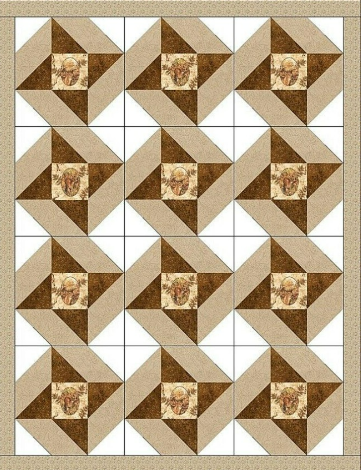
1. Selecting Fabrics and Tools for Your Friendship Star
Choosing the right materials is the first essential step in this Friendship Star Quilt- Tutorial. To make the star “pop,” you need a strong contrast between your background fabric and your star points. Most quilters opt for a neutral or light-colored background and a vibrant, patterned fabric for the star itself. Using 100% quilting cotton is highly recommended because it holds its shape well and is easy to press, ensuring your star points remain sharp and professional.
To begin your patchwork journey, you will need a few basic tools that make the process much smoother. A rotary cutter and a self-healing cutting mat are indispensable for getting those perfectly straight edges. You will also need a quilting ruler with clear markings to measure your squares accurately. Accuracy in the cutting phase is the foundation of a successful quilt block, as even a slight deviation can cause the corners not to line up later.
In addition to cutting tools, make sure you have a reliable sewing machine and high-quality all-purpose thread. A 1/4-inch quilting foot is a lifesaver for maintaining a consistent seam allowance, which is the golden rule of quilting. If you don’t have a special foot, you can use a piece of tape on your machine’s throat plate to mark the correct distance. Don’t forget a fresh microtex or universal needle to prevent skipped stitches.
Preparation also involves an iron and ironing board. Pressing is not the same as ironing; in quilting, we press the iron down to set the seams without stretching the fabric. This Friendship Star Quilt- Tutorial emphasizes pressing because it eliminates bulk and allows the seam intersections to lay flat. A flat block is much easier to quilt over than one with lumpy, uneven seams, so keep your iron handy throughout the entire process.
When considering the color palette, think about the mood you want to evoke. For a traditional look, reproduction fabrics from the 19th century work beautifully. If you prefer a modern aesthetic, try solid fabrics or low-volume prints for the background and a bold, monochromatic color for the star. This Friendship Star Quilt- Tutorial is versatile, so feel free to experiment with scrap quilting by using different fabrics for every star in a large quilt.
Finally, consider the size of the block you want to make. A standard 12-inch block is a great starting point for this Friendship Star Quilt- Tutorial. This size is large enough to show off your fabric prints but small enough to handle easily during assembly. Once you decide on the size, you can calculate how many squares and triangles you need. Remember, the Friendship Star is a nine-patch block, meaning it is built on a 3×3 grid of equal-sized units.
2. Cutting Your Pieces and Making Half-Square Triangles
Precision cutting is a core part of this Friendship Star Quilt- Tutorial. For a single Friendship Star block, you will need to cut five squares of your background fabric and two squares of your star fabric (for the triangles), plus one square of the star fabric for the center. The two squares used for the triangles should be cut slightly larger than the others to allow for trimming after they are sewn into half-square triangles (HSTs), which are the building blocks of the star.
The half-square triangle is a fundamental unit in quilting, and mastering it via this Friendship Star Quilt- Tutorial will unlock hundreds of other patterns. To make them, place one background square and one star square right sides together. Draw a diagonal line from corner to corner on the back of the lighter fabric. Sew two seams, each exactly 1/4-inch away from the drawn line. Once sewn, cut along the drawn line to create two identical HST units.
After cutting the units apart, open them up and press the seam toward the darker fabric. This technique, known as pressing to the dark side, prevents the seam allowance from showing through the lighter background fabric. Now comes a crucial step in our Friendship Star Quilt- Tutorial: trimming. Use your quilting ruler to trim these HSTs to the exact size of your other solid squares. This ensures every piece in your 3×3 grid fits together perfectly.
Repetition is key here. You will need four half-square triangles for every Friendship Star. Since each pair of squares makes two HSTs, you will repeat the sewing and cutting process twice. Take your time with the trimming process; it might feel tedious, but it is the secret to getting those “perfect points” that every quilter dreams of. If your HSTs are even a fraction of an inch off, the star will look skewed once assembled.
While cutting, always double-check your measurements. In this Friendship Star Quilt- Tutorial, we emphasize the “measure twice, cut once” rule. If you are making a full quilt, you might want to use the 8-at-a-time HST method to speed up the process, but for a single block, the 2-at-a-time method described above is the most accurate for beginners. Keep your fabric scraps organized, as they can often be used for smaller projects or quilt borders later on.
Once you have your four half-square triangles, four background squares, and one center star square, lay them out on your workspace. You should see the star pattern begin to take shape. The center square is surrounded by the four HSTs (placed so the colored triangles point outward), and the four background squares occupy the corners. This visual check is a vital part of the Friendship Star Quilt- Tutorial before you start sewing the rows together.
3. Assembling the Block Rows and Nesting Seams
Now that your pieces are cut and your HSTs are trimmed, this Friendship Star Quilt- Tutorial moves into the assembly phase. You will sew your nine units together in three rows of three. Start with the top row: sew a corner background square to an HST, then sew another background square to the other side. Repeat this for the middle row (HST, center square, HST) and the bottom row (background, HST, background). Use a consistent 1/4-inch seam.
A major tip in this Friendship Star Quilt- Tutorial is to pay attention to the direction of your star points. When sewing the half-square triangles to the center and corner squares, ensure the colored part of the triangle is oriented correctly to form the star’s “arms.” If you sew one upside down, don’t worry—your seam ripper is your best friend! Every quilter uses one, and it’s just a part of the learning process to get the star geometry right.
To ensure your block stays flat and the corners line up, you need to use a technique called nesting seams. When you press the seams of your rows, press the top and bottom rows’ seams in one direction (for example, toward the outside) and the middle row’s seams in the opposite direction (toward the center). When you go to sew the rows together, the seams will “lock” into each other, resulting in perfectly aligned quilt intersections.
Once the three rows are sewn, you will have three long strips of fabric. Now, pin the first row to the second row, matching those nested seams. This Friendship Star Quilt- Tutorial highly recommends using pins at every intersection to prevent the fabric from shifting under the needle. Sew the length of the row, then repeat the process to attach the third row. Your Friendship Star block is now fully assembled and should look like a beautiful, symmetrical star.
After the block is together, give it a final press. Pressing the entire block from the front ensures there are no accidental folds or “tucks” in the seams. If the block is slightly “wonky” or not perfectly square, you can do a light squaring up with your ruler and rotary cutter. However, if you followed the nesting seams and trimming steps of this Friendship Star Quilt- Tutorial, your block should be very close to the intended size.
The beauty of the Friendship Star is its simplicity. Because it is a nine-patch block, it is very sturdy and easy to join with other blocks. You can sew several of these blocks together to make a quilt top, or add sashing (strips of fabric between blocks) to give each star its own “frame.” This tutorial focuses on the block itself, but the possibilities for expanding it into a full bedspread or wall hanging are endless.
4. Finishing Your Quilt and Creative Variations
The final stage of our Friendship Star Quilt- Tutorial involves turning your finished block or quilt top into a completed project. This requires “the sandwich”: the quilt top, the batting (the middle fluffy layer), and the backing fabric. You can use safety pins or basting spray to hold these three layers together. This process, known as basting, prevents the layers from sliding around while you are doing the actual quilting.
When it comes to the quilting design, you have several options. For beginners, stitch-in-the-ditch (sewing exactly along the seam lines) is a great way to secure the layers without distracting from the star pattern. Alternatively, you could try free-motion quilting to add swirls or floral designs in the background squares. This Friendship Star Quilt- Tutorial encourages you to choose a style that matches your skill level and the intended use of the quilt.
Once the quilting is done, you will need to finish the edges with binding. Binding is a strip of fabric folded and sewn around the perimeter of the quilt to hide the raw edges. You can use the same fabric as your star to tie the whole look together. Learning to sew mitered corners on your binding is a great skill that you can apply to any future sewing project beyond this Friendship Star Quilt- Tutorial.
If you want to get creative, consider the Disappearing Friendship Star variation. This involves making a standard block and then cutting it into four pieces and rearranging them. It’s an advanced twist on the Friendship Star Quilt- Tutorial that creates a much more complex look with the same basic steps. You can also experiment with fussy cutting, where you center a specific motif from your fabric (like a flower or a small animal) in the middle square of the star.
Another popular variation is the Scrappy Friendship Star. Instead of using just two colors, use a different fabric for every star point. This is a fantastic way to use up your fabric stash and creates a vibrant, eclectic look. Many people use this Friendship Star Quilt- Tutorial to create “signature quilts,” where the center square of each star is a light solid fabric that friends and family can sign with a fabric marker at a wedding or baby shower.
Whatever variation you choose, the most important thing is to enjoy the process. Quilting is an art form that rewards patience and practice. This Friendship Star Quilt- Tutorial provides the structural foundation, but your creativity provides the soul. Each stitch you take is a connection to the long history of makers who have used the star motif to bring warmth and beauty into their homes and the lives of those they love.
FAQ – Frequently Asked Questions
What is the best fabric for a Friendship Star Quilt?
The best fabric is 100% quilting cotton. It is durable, easy to sew, and comes in an infinite variety of colors and prints. Avoid stretchy fabrics like jersey or slippery fabrics like silk when you are first following a Friendship Star Quilt- Tutorial, as they can be difficult to align.
How do I make my star points stay sharp?
To keep your points sharp, ensure you are using an accurate 1/4-inch seam allowance. When sewing the rows together, look at the back of your block; you should sew exactly through the “X” formed by the seams of your half-square triangles. This prevents you from “chopping off” the points of the star.
Can a beginner make a Friendship Star Quilt?
Yes! The Friendship Star is considered an entry-level block. While it looks more complex than a simple square, it only uses two types of units: solid squares and half-square triangles. It is the perfect project for someone looking to move beyond basic squares and learn star patterns.
What size should I cut my squares for a 12-inch block?
For a finished 12-inch block, each unit in the 3×3 grid must be 4 inches finished. Therefore, you should cut your solid squares at 4.5 inches (to account for seam allowances). For the HSTs, you should start with squares cut at 5 inches, then trim them down to 4.5 inches after sewing.
What is the difference between a Friendship Star and a Sawtooth Star?
A Friendship Star is a nine-patch block with four points made of half-square triangles. A Sawtooth Star is usually an eight-pointed star made with flying geese units. The Friendship Star is generally considered easier for beginners to assemble.
How do I wash my finished quilt?
Once your project from this Friendship Star Quilt- Tutorial is finished, wash it in cold water on a gentle cycle. Use a “color catcher” sheet in the machine to prevent dark dyes from bleeding into your light background fabrics. Air dry or tumble dry on low heat.
Conclusion
In this Friendship Star Quilt- Tutorial, we have covered everything from selecting the perfect quilting cottons to the final steps of binding and finishing. We learned that the secret to a beautiful star lies in the precision of your half-square triangles and the magic of nesting seams.
This pattern is more than just a design; it is a piece of history that celebrates the bonds of friendship and the joy of handmade crafts. By following these steps, you now have the skills to create a stunning quilt block that can be the centerpiece of a larger project or a beautiful gift on its own.