
Learning how to make crochet ball shapes is one of the most rewarding and versatile skills you can pick up in the crafting world, serving as the absolute foundation for amigurumi, holiday ornaments, and sensory toys. Whether you are a complete beginner looking for an easy first project or an experienced crafter wanting to perfect your spheres, this comprehensive tutorial will guide you through every single step of the process. Mastering the geometry of a perfect round shape might seem tricky at first, but with the right techniques, you will be creating flawless pieces in no time.
In this detailed how to make crochet ball – tutorial, we are going to break down the entire process from selecting your materials to closing the final stitch seamlessly. You don’t need any advanced mathematical knowledge to get this right; all it takes is understanding how consistent increases and decreases work together to form a seamless, smooth surface. By practicing this shape, you will build the muscle memory needed for larger, more complex fiber arts projects while creating something fun and tangible today.
By the end of this guide, you will understand exactly how yarn weight, hook size, and stitch tension influence the final look and durability of your work. We will also explore crucial insider secrets, like why the invisible decrease is a total game-changer for stuffing-heavy projects and how to avoid the dreaded “pointy egg” shape. Grab your favorite yarn, find a comfortable spot to sit, and let’s dive into the ultimate how to make crochet ball guide!
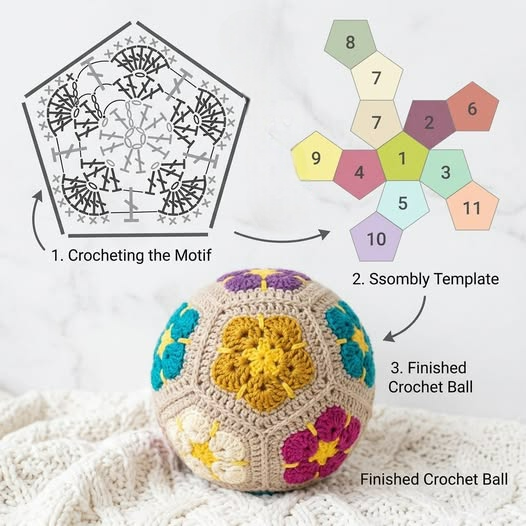
1. Choosing the Right Materials for Your Crochet Ball Tutorial
When learning how to make crochet ball items, selecting the correct yarn and hook combination is your very first step toward success. For beginners, a medium weight yarn—specifically worsted weight yarn (Category 4) made from acrylic or cotton—is highly recommended because it provides excellent stitch definition. Cotton yarn is particularly fantastic for a crochet ball because it does not stretch out of shape easily when stuffed, ensuring your sphere stays perfectly round over time.
Your choice of crochet hook size is equally critical to the structural integrity of your finished project. While yarn labels always suggest a hook size, amigurumi and spherical projects require you to size down significantly to keep your stitches tight. If your yarn recommends a 5.0mm hook, try using a 3.5mm hook (E/4) or a 3.25mm hook instead to prevent the stuffing from peeking through the gaps.
Another essential tool you will need for this how to make crochet ball – tutorial is high-quality polyester fiberfill stuffing. This material is lightweight, washable, and holds its bounce, which is exactly what keeps your spheres looking plump and uniform. Do not skimp on the stuffing, but be careful not to overstuff to the point where your stitches begin to stretch apart and reveal the interior.
You will also need a few basic notions that make the crafting process much smoother and less frustrating. A stitch marker is absolutely non-negotiable because this project is worked in continuous rounds without joining, meaning it is incredibly easy to lose your place. Keep a trusty pair of sharp embroidery scissors and a blunt-tipped yarn needle nearby for weaving in your loose ends later.
Understanding how these materials interact will dramatically improve your workflow and the final aesthetic of your project. If your hook is too large, your ball will look loose and sloppy; if it is too small, your hands will cramp up from fighting the tight tension. Finding that sweet spot with a comfortable ergonomic hook will make your crafting session incredibly enjoyable and productive.
Before making your first loop, ensure your workspace is well-lit so you can easily count your individual loops and chains. Having organized materials allows you to focus purely on the rhythm of your hands, which is where the real magic happens. Now that your crafting station is fully prepped with the ideal gear, we are ready to move on to the actual foundational stitches.
2. Master the Foundation with the Magic Ring Technique
Every great how to make crochet ball journey begins with a solid foundation, which almost always means mastering the magic ring (also known as the magic circle). This clever technique creates an adjustable loop that can be pulled completely tight, leaving absolutely no hole at the very top of your sphere. If you use a traditional chain-and-join method instead, stuffing will inevitably leak out of the top, ruining the clean look of your tutorial project.
To create a magic ring, loop the yarn around your fingers to form an “X”, insert your hook under the first strand, and pull the working yarn through. Chain one to secure the loop on your hook, and you are ready to begin working your initial stitches directly into that adjustable circle. For a standard, well-proportioned sphere, the golden rule is to place six single crochet (sc) stitches inside this opening.
Once your six initial stitches are nestled into the circle, grab the short tail of your yarn and pull it firmly to close the center hole completely. At this point, do not join the round with a slip stitch; instead, place your stitch marker directly into the very first stitch you made. This marks the end of your first round and prepares you to transition seamlessly into working in continuous, spiral rounds.
The second round is where we begin expanding the circle by applying a fundamental math concept: the crochet increase (inc). To increase, you simply work two single crochet stitches into the exact same loop from the previous row, effectively doubling your total stitch count. For Round 2, you will perform an increase in every single stitch around, bringing your total count from six up to twelve.
As you move into Round 3, you will establish a rhythmic pattern of alternating between a single stitch and an increase stitch. The sequence for this round is to make one single crochet in the first stitch, followed by an increase in the next stitch, repeating this pattern six times. Following this exact formula guarantees that your flat circle expands evenly without curling or warping into an awkward shape.
Maintaining consistent tension during these foundational rounds sets the tone for the rest of your how to make crochet ball project. If your stitches are too tight here, it will be incredibly difficult to insert your hook during subsequent rounds, leading to hand fatigue. Take your time with these initial steps, as a clean foundation ensures the rest of your sphere looks incredibly professional.
3. Growing and Shaping the Body of Your Sphere
Now that your foundation is secure, this how to make crochet ball – tutorial moves into the growth and shaping phase, where the circle transforms into a three-dimensional object. To keep expanding the circle evenly, Round 4 requires a pattern of working one single crochet in the next two stitches, followed by an increase. This systematic expansion brings your total stitch count up to twenty-four, creating a wide, flat base for your sphere.
The final expansion round for a standard-sized ball is Round 5, where you will crochet one single stitch into the next three spaces, followed by an increase. Repeating this sequence six times brings your final, maximum stitch count to thirty, which is the perfect size for an easy crochet ball project. If you wanted to make a much larger ball, you would simply continue this math pattern, adding one more single stitch between increases each round.
Once you reach your desired maximum diameter, it is time to build the actual height and body of the sphere by working even rounds. During these rounds, you will stop increasing entirely and simply place one single crochet into every single stitch around the perimeter. For this specific size, you will maintain thirty stitches per row for the next five rounds (Rounds 6 through 10).
These even rounds are what cause the flat circle to cup upward, naturally forming the walls and center equator of your ball shape. It is incredibly relaxing to work these rows because you do not have to worry about complex counting patterns or calculations. Just keep moving your stitch marker up at the end of every row so you never lose track of your progress.
While working these middle rows, it is the perfect time to identify the “right side” versus the “wrong side” of your fabric. The right side should face outward, featuring clean, interlocking “V” shapes, while the wrong side has horizontal bars and should face the interior. If your piece starts cupping backward, simply pop the center out with your thumb so the beautiful texture faces the world.
Consistently counting your stitches at the end of each middle round is an excellent SEO optimization habit for your workflow to prevent asymmetrical shapes. If you accidentally lose or add a stitch during this phase, your ball will look lopsided or lumpy once stuffed. Take a quick five seconds after each round to count to thirty, ensuring your sphere remains absolutely flawless.
4. Decreasing Safely and Stuffing the Ball Seamlessly
The final phase of learning how to make crochet ball structures involves mirroring your earlier increases with precise, clean decreases to close the shape. To achieve a professional finish that matches the quality of high-end amigurumi, you must use the invisible decrease (inv dec) method. Traditional decreases can leave bulky bumps or noticeable gaps, whereas the invisible method keeps the texture completely uniform and tight.
To execute an invisible decrease, insert your hook into the front loop only of the first stitch, and then immediately into the front loop only of the second stitch. Yarn over, pull through both of those front loops, yarn over again, and pull through the remaining loops on your hook to combine them into one. For Round 11, you will repeat a pattern of three single crochets followed by one invisible decrease all the way around.
As the opening of your crochet ball begins to narrow, Round 12 will require a pattern of two single crochets followed by an invisible decrease. At this point, your stitch count drops down to eighteen, and the opening is just large enough for you to begin adding your material. Take small clumps of your polyester fiberfill and gently push them into the opening, shaping the ball with your fingers as you go.
Round 13 continues the narrowing process with a sequence of one single crochet followed by an invisible decrease, leaving you with just twelve stitches remaining. This is your absolute last chance to add any final bits of stuffing to achieve the perfect level of firmness. Use the back of your crochet hook to push the stuffing into the outer edges, ensuring there are no hollow spots or flat zones.
The final round, Round 14, consists entirely of six consecutive invisible decreases, which brings your final stitch count back to the original six you started with. Cut your yarn, leaving a generous eight-inch tail, and pull the loop all the way through to secure the stitch. Thread this long tail onto your blunt yarn needle so you can cleanly close the tiny remaining hole.
To finish this how to make crochet ball – tutorial, insert your needle through the front loops of the remaining six stitches from the outside in, and pull firmly. The hole will magically zip shut like a drawstring, leaving you with a perfectly seamless, round ball. Knot the yarn securely against the surface, push the needle through the ball to hide the tail inside, and clip the excess yarn away.
Frequently Asked Questions (FAQ)
Why does my crochet ball look like an egg instead of a perfect sphere?
An oblong or egg-like shape usually happens if you add too many or too few even rounds in the middle of your project. The number of middle rows must perfectly balance your increase and decrease sections to maintain symmetry. Additionally, overstuffing the top or bottom while leaving the center loose can distort the final geometry.
What is the difference between a standard decrease and an invisible decrease?
A standard decrease loops through both top strands of a stitch, creating a thick, raised ridge that stands out on a smooth sphere. The invisible decrease only utilizes the front loops, which keeps the reduction completely flat and identical to the surrounding single crochet stitches. It is the gold standard for clean amigurumi design.
Can I use any type of yarn to make a crochet ball?
Yes, you can use any yarn, but different fibers yield vastly different results for a crochet ball. Beginners should stick to a structured cotton or low-fuzz acrylic yarn because fuzzy or textured yarns make it very difficult to see your stitches. No matter what yarn you pick, always remember to choose a hook that is one or two sizes smaller than recommended.
How do I prevent the stuffing from showing through my stitches?
The secret to hiding your stuffing is maintaining a very tight tension and using a downsized crochet hook. If your hook matches the label’s standard recommendation, your loops will be too loose, creating windows that expose the white fiberfill. If you naturally have loose tension, sizing down your hook even further will easily solve this issue.
How do I wash my finished crochet ball?
Washing guidelines depend entirely on the fiber content of your yarn and the type of stuffing used inside. If you used premium acrylic or cotton yarn along with standard polyester fiberfill stuffing, you can safely place the ball inside a mesh laundry bag. Wash it on a delicate, cold cycle and allow it to air dry completely to preserve its shape and bounce.
Conclusion
In this comprehensive how to make crochet ball – tutorial, we have covered everything required to build a flawless, professional-grade round sphere from scratch.
We explored the vital importance of choosing a smaller hook to lock in your stuffing, mastered the seamless entry of the magic ring, and navigated the precise mathematical symmetry of increases and decreases. By integrating the invisible decrease into your toolkit, you now possess the core foundational skill required to dive confidently into the wonderful world of amigurumi and geometric fiber arts.